TED Blog

Main

27 August 2008

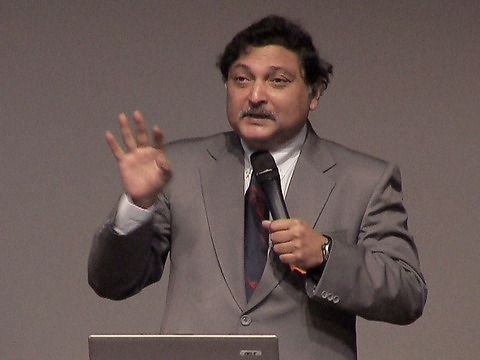
How kids teach themselves: Sugata Mitra on TED.com

At the LIFT Conference, in Geneva, Sugata Mitra discusses his “Hole in the Wall” project in India, which proved that kids, without education or instruction, can figure out how to use a PC on their own — and then teach other kids. Given this, he asks, what else can children teach themselves? (Recorded January 2007 in Geneva, Switzerland. Duration: 20:59.)

(Note: We first posted this talk in November ’07, then took it offline for some necessary, and complicated, audio repairs. The sound quality is still not perfect, but the talk is so powerful, we’re thrilled to be able to share it.)

Watch Sugata Mitra’s talk on TED.com, where you can download this TEDTalk, rate it, comment on it and find other talks and performances from our archive of 275+ TEDTalks — including many more talks on education.

Get TED delivered:
Subscribe to the TEDTalks video podcast via RSS >>
Subscribe to the iTunes video podcast
Subscribe to the iTunes audio podcast
Get updates via Twitter >>
Join our Facebook fan page >>

Subscribe to the TED Blog >>

Bookmark and Share
  • Gunjan Raizada Chakravarty

    Aug 30 2008

    I heard the talk by Sugata Mitra. I agree with him partly. Yes, young kids are the roots which needs to be given space and water. Space to explore and water in terms little guidance. After teaching at the local university, I did some experiments with my 9 year old duaghter’s class. The results are on youtube, learing the concepts of speed, velocity and projectile motion through playing, w/o any textbook or equations. Simply through awareness. The link to a brief 4:30 minutes clip put up on Youtube is on my blog at
    http://surrenderlistenandgive.blogspot.com/2008/05/exploring-speed-angle-and-projectile.html
    and the complet script behind this presentation is at:
    http://surrenderlistenandgive.blogspot.com/2008/04/exploring-launching-of-satellites.html
    I wish that poorer kids with no parents or uneducated parents get to benefit from this alternate technology. But I do not know how?
    Also, I wish that average or below average child starts exploring Physics before losing interest in middle/High schools.
    This is my sincere wish and I hope it gets arranged.

  • David Smith

    Sep 1 2008

    I think this is fascinating. I honestly believe that through millions of years the development of problem solving ability is best enabled in this kind of hands on kinaesthetic way. We would for most of our evolutionary past have spent our time imagining how to better attach that spear point or how the shaft would fly better when its smooth. We had no knowledge of aerodynamic theory, but that which forms the basis of the theory i.e. the experiential doing we did have. I feel we still have vast creative layers which go unattended to by traditional educational approaches to learning, at least for a large percentage of learning styles.

    I also think based on my own experience that education can stifle inspiration in some ways by standardising the process of discovery and that nature itself should be the classroom and the teacher.

  • Crystal Layden

    Sep 3 2008

    I do admire him. The Hole-in-the-Wall experiment has the potential to bring computer literacy to millions of Indians across the land. Salute for him.

  • Bala B

    Sep 6 2008

    I too got a chance to hear the talk by Sugata Mitra… it was good! Like many, I too pray let this bring about a new dimension in making IT education far more reachable to the needy poor kids, and I really hope it will for sure.

    Bala

  • digi klan

    Sep 27 2008

    i know he says sweet things. but it is not easy to have a career and education on it area.
    still it is very difficult and expensive to have a good training.

  • Jenny Hopper

    Oct 10 2008

    Given the write tools ie Computers, Books etc. I believe he is write the kids could learn. But they would need some assistance with getting started I believe. I work with children that have cancer and love the computers it distracts them from there worries.


Read the TED Prize Blog at TEDPrize.org
Read the TED Fellows Blog
Read the TEDx Tumblr

Find stories on the TED Blog about:

TED on Facebook

Like TED
on Facebook


@TEDTalks on Twitter

Follow TED on Twitter:
@TEDNews | @TEDTalks


RSS

Subscribe to TED RSS feeds:
TED Blog | More RSS Options


Subscribe to TED's weekly newsletter


See 1,000+ TEDTalks in a spreadsheet:


http://tedconfblog.files.wordpress.com/2010/07/spreadsheetscreen.jpg

Looking for lightweight downloads? Use TED's Quick List


Spot a glitch on TED.com? Report a bug


TED takeaway


TED ringtones:
TEDTalks Classic tune in [mp3] [m4r]
TEDTalks Phase II tune in [mp3] [m4r]

TED Bloggers

Chris Anderson | Curator
June Cohen | Executive Producer of TED Media
Emily McManus | Editor, TED.com
Bruno Giussani | TED European Director
Jason Wishnow | Director, Film + Video
Jim Daly | Editor, TED Books
Guestblogger: Ben Lillie | Curator, the Story Collider
Guestblogger: Helen Walters | Thought You Should See This
Guestblogger: Karen Eng | Youth editor, TUNZA
Guestblogger: James Duncan Davidson | Photographer
Guestblogger: Rachel Tobias | never-have-i-ever.tumblr.com

Blogs we watch

+ TEDPrize.org
+ TED Fellows blog
+ TEDx Blog
+ tedquotes.tumblr.com
+ Thomas Dolby | TED Musical Director, blogging at ThomasDolby.com
+ The indispensable Global Voices

Watch the 4-minute video A Taste of TED2012:


http://tedconfblog.files.wordpress.com/2012/03/tasteofted2012.png

This work is licensed under a Creative Commons license.

Powered by WordPress.com VIP