[ted id=161]
Today, Erin McKean realized the idea that forms the base of her 2007 TED Talk with the launch of Wordnik.com, a dictionary that evolves as language does. On Wordnik, users can add new words and meanings, tag words with related expressions, see real-time search results for words from Twitter and Flickr, discover how many Scrabble points each word is worth — all on one page.
Here’s what it looks like when we search the word “blog”:
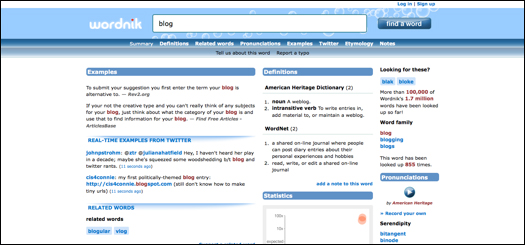
To further understand this amazing project and its implications, the TED Blog talked with Erin this afternoon. In the middle of a hectic launch day, she gave the following excited interview:
We love Wordnik here at the TED office. Some of us may have spent the majority of the morning playing with it.
That’s great! We’ve been joking that we’d like to be so addictive that IT managers ban us.
So, how long has this been in the making? You talked about a similar concept in your TED Talk from 2007, but when did it start concretely?
We consider Leap Day of 2008 our real start date. It was almost a year after the TEDTalk that we got together the money and the team.
We’ve heard that Wordnik.com may have had its beginnings at TED? Can you confirm this rumor?
Yes, yes! It was after the talk at TED that Roger McNamee said, “Let’s have lunch.” I had lunch with him and his wife Ann. We started with the idea that we could use language analysis techniques to help other companies. But as we were discussing it, we realized that it wouldn’t be all that different to start this as a stand-alone being.
Then Roger brought in Steve Anderson of Baseline Ventures. Steve gave a lot of advice on the practical end, which was great, because my career as a dictionary editor did not completely prepare me for my new role as a start-up CEO. I found Grant Barrett and Orion Montoya who I worked with at Oxford University Press. Steve and Roger then found Tony Tam, who became our head of engineering. And that was the beginning of our staff.
Without TED this would not have happened. There’s zero chance that I would have met Roger McNamee, and even less of a chance that I would have had 20 minutes to speak at him. The TED video was also a great recruiting tool because when I needed to explain my idea I could just email the link. You know, for when people ask, “Who’s Erin? What does she want to do?” I could just direct them to the talk.
Everyone at TED has been so helpful. Tom Rielly has given me so much support. And I had a conversation with June (Cohen) this morning where she offered to add the transcripts for the TED Talks to our text examples. So when you look up a word like “synecdochically,” which I mention in my talk and probably isn’t found in many other places, there will be a reference. And, because the transcripts link to the actual video, people can hear the words for which we didn’t have a link to the pronunciation.
That’s another thing about this system — people who are contributing don’t even know they are. If you tweet a word, we’ll link to your tweet on Wordnik, so you don’t even have to go out of your way.
We love that you included Twitter and Flickr elements. How did you decide on pulling these in? It doesn’t seem to be an immediately intuitive decision, but is so helpful to understanding a word’s use and meaning.
It’s funny because it’s completely intuitive to dictionary editors. How can we show how a word is really used? The other day I tried to find out if “pants” was being used as a suffix and I found a tweet for “awesomepants.” Twitter is like overhearing people’s conversations, which is exactly what dictionary editors have been wishing we could do for years.
Flickr — well, if you’ve looked at dictionary illustrations you know that they tend to be uninteresting, and so small. With Flickr, you get a lot of abstractions too. What dictionary would have pictures of “honor”? When you look “honor” up on Wordnik, you get pictures of women named Honor, which tells you that it’s also used as a proper noun. You also get images of flags and different symbols of the military. Now you can see what feelings words evoke.
Interesting. We were also wondering what the source was for the text examples of words …
Right now the majority are from the Gutenberg e-text — these are books that all out of copyright. But we’re working with partners on getting bigger feeds. We’re not really worried. There’s a 400-year-old tradition of example sentences in dictionaries being treated as fair use. Also, if we use somebody’s work and they’re not happy, they can call us and we’ll take them out of the history of the English language.
What words are you looking forward to people adding?
I’m really looking forward to seeing Twitter used to invent new words. I’m more interested in seeing how people deepen and expand the network of words than seeing any words in particular. I really can’t wait to see what will happen with the tagging function. Already, if you look up the swine flu tag, you find words like “aporkalypse” and “hamdemic.” You would never find these in a regular dictionary! We’re trying to make the ephemeral more permanent. And, again, it’s less about the individual word and really about expanding how words are connected. After all, we don’t speak in one-word exchanges.
As a last question, I’d like to ask how you came to your theory on words — that, as a dictionary editor, you would rather be someone who gathers all words than someone who keeps “bad” words out of the dictionary?
I guess I was thinking about it as a lapse in critical thinking. Brilliant people would come to me and say, “Is this right, or this?” And then I’d give them the evidence on both sides and say, “Now, make up your own mind.” And they’d say, “No, I want the answer.”
Now, these were people who would never consider doing this in any other area of life. For anything else, they would use the evidence to come to their own conclusions. These were people who probably wouldn’t take my recommendation on a restaurant. But in this respect, they were willing to accept whatever answer I gave them. Instead of this, we want to give everybody access to the words, to make up their own minds.
Also, whether words are right or wrong can vary according to use. I might say to a friend , “That movie was awesomepants!” But I would not lead into a movie review in The New York Times with the word awesomepants. That would be inappropriate. People expect that one size fits all with words, when that doesn’t work in any other area of their lives. I hope that we can change that view.
Comments (13)
Pingback: Botwiki Interview: Erin McKean | Botwiki
Pingback: Wordnik or another way to say I’m in love! | Everything you want to know about teaching English
Pingback: Writing 502 » Change to October 9 Reading
Pingback: DICTIONARIES GONE WILD: Our Works and Days Online « brucejquiller