Via Discover magazine via Akiyoshi Kitaoka:
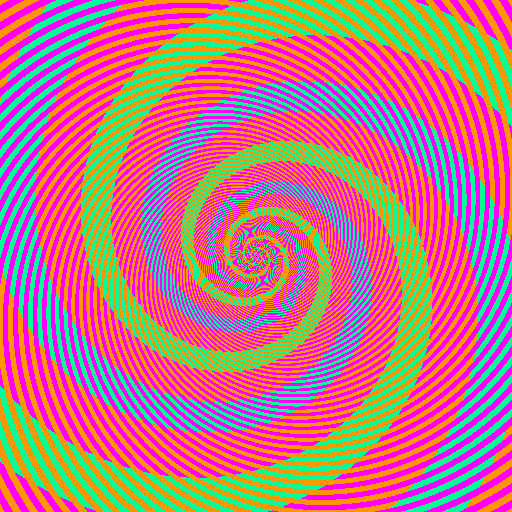
Incredibly, the blue and the green spirals are the same color. From the article:
The orange stripes go through the “green” spiral but not the “blue” one. So without us even knowing it, our brains compare that spiral to the orange stripes, forcing it to think the spiral is green. The magenta stripes make the other part of the spiral look blue, even though they are exactly the same color.
Two TEDTalks on our mis-wired brains: Dan Dennett and Al Seckel.


andy tulett commented on May 17 2011
its a fake, check out what i found inside it
the main green is the same colour but the rings have lighter and darker shade pixels spread out inside them – like having a dirty carpet and hoovering one side.
http://i.imgur.com/ItFbW.jpg
and
http://i.imgur.com/IrQ0D.jpg
Zero Cyde commented on Jun 26 2009
No, the RGB value of both the “Green” and “Blue” spirals is R:0 G:255 B:150
Brandon Baum commented on Jun 26 2009
You are correct.
Charlie Ferguson commented on Aug 20 2009
It gets worse. Our perception of color is entirely subjective. e.g., we cannot agree that our perception of the color of an orange is the same. How can I prove to you that what I “see” is the same as what you see. Perhaps your perception is what I would call blue. We will always agree that the fruit orange is perceived as “orange” and the wavelength 600 nm is “orange”, but can’t know that our experience is the same. There’s is no reason to disbelieve it but there is no way to prove it.
Ward Sharlow commented on Aug 19 2009
We see this kind of thing frequently in printing. A designer will use a company’s logo, keeping intact the color specification. Then, once the client comes for press check, they’ll swear that the logo color is wrong because it’s now in the middle of a field of some other color. You compare a sample and a press proof using a spectrophotometer, and they still won’t believe you.
For fun, lay a red sample on a yellow background and ask someone by memory to pick the sample color out of the Pantone book. The PMS guide is always printed on bright white paper, so the re-calibration of your eyes will normally have you guessing something much more magenta. It’s pretty surprising how wrong you can be.
dennis hoff commented on Jul 4 2009
There are a lot of funny illusions on the net
Warren Lytle commented on Jul 1 2009
Wow that makes me dizzy!
Elizabeth Baum commented on Jun 26 2009
Didn’t one of Dan Ariely’s TED talks begin with an illusion like this? His premise was that even after we prove to ourselves that we are incorrect in an assumption, this doesn’t change how we interpret the same information later, so we will continue to behave in accordance with the incorrect assumption.
Philipp Engelhorn commented on Jun 25 2009
in case anyone else was confused: the blue and the green are the same color! crazy! went into a photo editor to delete the orange and magenta and it’s true!
Cameron Micules commented on Jun 25 2009
Anybody out there suffer from color-blindness able to see the colors properly? Does that then mean that those of us who don’t ‘suffer’ from the condition are actually the ones with a ‘condition’?
Erin Garlock commented on Aug 20 2009
You can get a pretty good simulation of what a color blind person would see by using VisCheck – http://www.vischeck.com/vischeck/vischeckImage.php
Kevin Kopp commented on Jun 25 2009
It’s cool to go into a photo editor and fill in the magenta and orange, and watch the colors change instantly… http://bit.ly/9unXR
Chris Anderson commented on Jun 26 2009
Great link, Kevin.
Laura Cococcia commented on Jun 25 2009
If that visual doesn’t inspire us to “look twice” or “think twice” than I don’t know what does. Interesting commentary about how are brains are wired – seems like we have a slight power to unwire them using a bit of will and perspective shift…