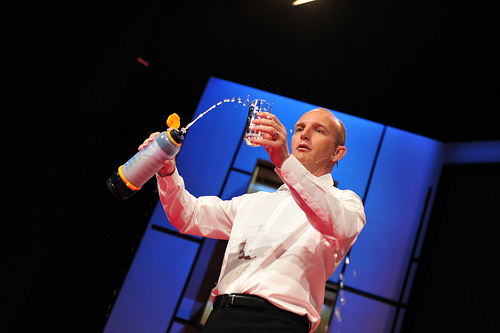
Michael Pritchard at TEDGlobal 2009, Session 7: July 23, 2009, in Oxford, UK. Credit: TED / James Duncan Davidson
Inventor Michael Pritchard‘s talk involves a strange prop — a large aquarium filled with cloudy water. After being introduced, he explains that he’s here to talk about water. He asks how the water at the conference has been and points out that audience is probably sure it’s from a safe source. “But what if it wasn’t?” he asks. Then, he declares that half the conference would suffering from diarrhea. He thinks that its that scale of the problem that overwhelms governments and aid agencies. Since he’s been speaking, he tells us, 13,000 people in the world have been suffering with diarrhea and four children have died because of unclean water.
Pritchard says that he invented the Lifesaver bottle because he got angry while watching the tsunami in Thailand play out and watching people forced to drink contaminated water or face death. He points out that, months later, Hurricane Katrina hit and he hoped for the US to do better. It took five days to get water to the Superdome. So, he began spending a lot of time in his garage and kitchen over the next weeks and months to develop a product that could help.
Before the Lifesaver, he says, the best filters could only filter particles larger than 200 nanometers, which is the size of the smallest bacteria, so some bacteria got through. And, the smallest virus is 25 nanometers. The Lifesaver’s pores are 15 nanometers. Nothing gets through, Pritchard declares.
Then, he begins his demo. He points to the aquarium, which he says contains water from nearby rivers, like the Thames. Then, he pulls out another container and adds water from his pond at home. Then he adds run-off from a sewage plant, other “bits an piece” and a “gift” from a friends rabbit and gives it a stir. He scoops the filthy water up and pours it into the Lifesaver bottle, which looks quite like any regular plastic sports water bottle. He replaces the top, pulls out a hidden pump mechanism and gives it a few pumps. He pours clear water from the bottle into a glass and hands it to Chris Anderson to have a taste. Anderson does, and declares it completely potable.
Pritchard says that the filter in the Lifesaver is good for 6,000 liters. When it expires, the system will shut off to protect the consumer. In a crisis, he explains, we ship water and people are forced to got to camps to get water where diseases spread and the problem intensifies. By shipping these instead, people can stay put.
Now doesn’t require a natural disaster for this to work, he continues. We could use the Lifesaver bottle or the same technology on larger scale where people routinely have no access to clean water and it costs 1/2 cent per day to run. Mothers and children would no longer have to walk four hours to get their water. According to his calculations, with only $20 billion we can have safe water for all. Pritchard reminds us that the UK alone spends $12 billion on aid each year.
Comments (1)