At TED2009, Stanford Professor and virus hunter Nathan Wolfe explained that most human diseases — AIDS, SARS, swine flu — originally came from animals. Today, Wolfe and his team announced an intriguing discovery that throws new light on an ancient disease, and provides new hope for its cure: Malaria, long believed to have evolved with humans, actually originated with chimpanzees and jumped to humans later on.
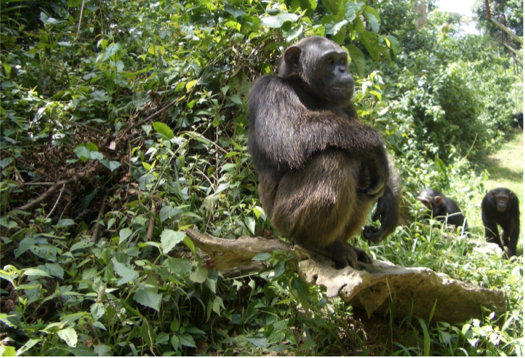
By collecting blood samples from nearly 100 wild and wild-born chimpanzees in central Africa — including those in the photo above, in Cameroon’s Mfou National Park (Photo: Nathan Wolfe/GVFI) —Wolfe and his team discovered eight new variants of the parasite that causes malaria in chimps. Only one strain of chimp malaria was previously known, and it was believed that it had evolved separately from human malaria.
With this new treasure trove of genetic data, Wolfe and his team at the Global Viral Forecasting Initiative were able to analyze the disease’s lineage more closely. They found that chimp malaria was far more genetically diverse — and therefore older — than its human form, and concluded that a strain of malaria jumped from chimps to humans (perhaps thousands or tens of thousands of years ago). This strain evolved into the parasite that now causes a staggering 500 million cases of human malaria — and 1 million deaths — annually.
“This discovery shows that malaria jumped from chimps to humans, in much the same way that HIV did,” Wolfe said in a phone interview. “This has interesting implications for my work, because it provides historical context: We’re clearly seeing an acceleration of the rate at which viruses jump from animals to humans. But this is an ancient phenomena. Pandemics born thousands of years ago are still around. And pandemics born today might be around thousands of years from now.”
The discovery, published today in the Proceedings of the National Academy of Sciences, also presents new possibilities for a cure. Scientists often tap pathogens in the same family in order to develop vaccines and treatments. For example, “vaccinia” — a mild virus in the “pox virus” family — was used to create the Small Pox vaccine; it initiates a mild immune response in humans, and the antibodies work against Small Pox as well. It’s possible, Wolfe said, that one of the eight newly discovered malaria strains “could hold the key to a future vaccine.”
That would be good news for Wolfe, who’s been infected by malaria three times, and nearly died of it five years ago.
But — old grudges aside — the discovery is interesting to Wolfe on a more abstract level, because: “It solves a fundamental mystery,” Wolfe said. “Malaria is as old as human history. People have always wondered about malaria and where it came from. And our assumptions were wrong.”
Read more about the discovery on Wired News and CNN.
Watch Nathan Wolfe’s 2009 TEDTalk:
Comments (4)
Pingback: Buy Steroids with Bitcoins
Pingback: TEDxSalford – Fighting Disease, Thinking Differently - TEDxSalford