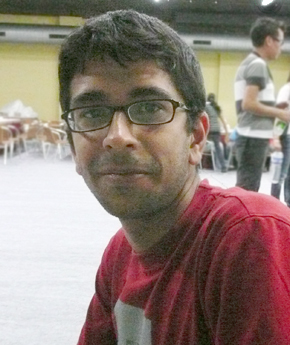
 Ishan Bhalla is a volunteer at TEDIndia. TEDIndia volunteers — there are about 30 of them — will be onsite throughout the conference helping with registration, special requests and generally making things run smoothly. We spoke to Bhalla after orientation on Saturday.
How did you find out about volunteering at TEDIndia?
I’d been following the TED.com website for a while, and when I saw on the website that there’s a TEDIndia coming, I knew immediately that I wanted in. I sent email to the manager here, telling him that I would be a volunteer, waiter, sweeper, anything.
What will you be doing onsite?
We haven’t had our assignments yet, but one job I’d like is, if one of the guests want something, arrange it for them. Let’s say they want something delivered to their room. Or requests for information. Just to be helpful.
Watching the volunteers this morning, I was struck by your teamwork. You’re systems thinkers. You talked together about the best way to do a particular job, then sat down and did it. So I have to ask: Is everybody on this team an engineer?
I think yes. It’s a good guess to say 90 to 95 percent are engineers.
Are you? Do you work for Infosys?
I do. I’m an engineering analyst. I work in the department of Infosys that does solutions for engineering; for example, in the auto or aero sector. Our work is basically building applications that would improve the productivity of someone doing, say, an aircraft design, by taking a portion of the design cycle and automating that process. Because some of the processes are very repetitive. What we do is take some of the rules that are in the designer’s head and write them down and build our applications to automate CAD processes, for instance.
What’s your favorite TEDTalk?
My favorite TEDTalk is Ken Robinson. Apart from the content, which is absolutely great, his presentation, the way that he puts in those little funny things in between, I thought it was brilliant. It’s a great talk. I’ve seen it like 6, 7 times.
The other one that I watch often is Yves Béhar, from fuseproject, because I’m very interested in design; that is what I want to take up as my future career. That talk really inspired me specifically, because I saw it at a point where I was trying to figure out my life, what am I going to do in my career going forward. Also the founder of IDEO, David Kelley, his talk on human-centered design. This talk is what pointed me to human-centered design.
Tim Brown‘s recent talk was interesting too, because he talks about using design to solve bigger problems, and that is something very close to my heart. I would like to explore the use of design to solve problems which are socially relevant. I’m not talking about social work specifically but problems that people have, real-life problems, especially in economically backward areas. Because that’s a huge population in India.
I believe that a lot of design is targeted at a western audience. And those products come in to India, but they’re not necessarily designed for India. And I believe there’s a huge potential for that; I also think there’s a huge need for that. As an example, a simple interaction thing: the radio button. You know where the radio button comes from — it’s a metaphor, right? It comes from car radios, where the button can be pressed only one at a time. But people over here are not familiar with that kind of a control. We don’t have those kinds of radios in our cars. If I go and ask somebody what a radio button is, they’ll say it’s an interaction mechanism, but they don’t relate to the source of that metaphor. This is just a very simple example, but let’s say if we are targeting populations in a low-literacy area, who have not had the exposure to things that we have, like technology, we might need to find metaphors from their world to explain new concepts to them. That’s very exciting.
Follow Ishan Bhalla at @lukwhostalking
Comments (2)