TED Blog

Main

10 February 2010

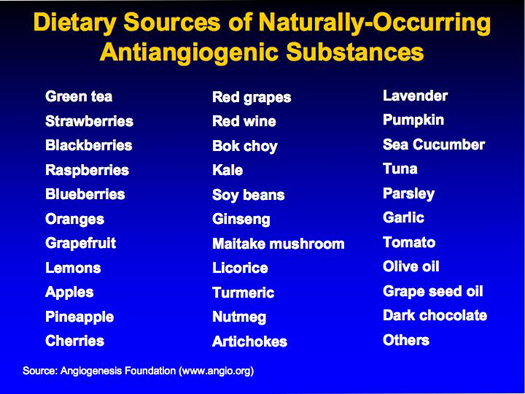
Dr. William Li's list of antiangiogenic foods

A much-requested slide from Dr. William Li’s TEDTalk in Session 2:

Antiangiogenic.jpg

Courtesy The Angiogenesis Foundation

Bookmark and Share
  • Bo Yu Chen

    Feb 10 2010

    Very informative. I love everything on the list and I eat most of them often, Bok Choy is heavenly delicious when you cook with soy sauce.

  • Jeffrey Cufaude

    Feb 11 2010

    Excellent info on the slide, but someone get a slide designer in here stat. This is perhaps the most over-used background and text combo in the history of PowerPoint.

    • T McGiver

      Feb 12 2010

      Slide worked fine for me. Maybe you need to speak with your optometrist?

    • Marina Morales

      May 19 2010

      hahahha, the slide is just fine, blue bg and white text….yellow titles… it works!

  • Rahmin Sarabi

    Feb 12 2010

    Great slide, but I’m confused why grape seed oil was included in the list. Grape seed oil is ~70% linoleic acid (omega-6), which is believed to be a significant contributor to oxidization of LDL and Heart Disease.

    Any thoughts?

  • John La Puma

    Feb 19 2010

    Glad to see these ideas about healthy food, healthy you are getting traction: we call it “culinary medicine” and the more people, the better. I’m asked about breast cancer more than any other, but some of the very best data for food and cancer is in colorectal: remarkable data published in JAMA and elsewhere show prevention of recurrence with the right diet.
    JL
    http://drlapuma.com
    Author, ChefMD’s Big Book of Culinary Medicine

  • Tom Gilboy

    Mar 3 2010

    Hope this talk is posted soon. I have a friend diagnosed with mesothelioma last week who’s now trying to put together a way to deal with it, and this looks promising.

  • Terry Moore

    May 9 2010

    This was one of the most interesting presentations of TED2010. Why isn’t it available yet?

  • Mary Goodson

    May 17 2010

    From the texts of the Baha’i Faith:

    “… it is possible to cure by foods, aliments and fruits; but as today the science of medicine is imperfect, this fact is not yet fully grasped. When the science of medicine reaches perfection, treatment  will be given by foods, aliments, fragrant fruits and vegetables…”
    ~ Abdu’l-Baha

  • Mary Goodson

    May 17 2010

    I’d love to hear Dr. Li’s insights about the benefits of LIVE foods over those picked and shipped many miles. I’ve been using the Live Green Smoothie diet for a couple of months, and have lost 50lbs. His talk explains why this works so incredibly well!

    http://www.live-green-smoothie-diet.com/whats-a-live-green-smoothie-anyway/

  • Whisang Jo

    May 18 2010

    Wow.. it’s really informative. But once take a look this list, just got to know “wow they are so normal foods!” if I tried, it could have been able to take any of them at any grocery shop though” So, what really matters is “one’s attention to these food for antiangiogenics”
    Otherwise it exactly will be the same. Have to send this slide to my wife and parents.

  • Tim Jessup

    May 26 2010

    Rahmin

    http://circ.ahajournals.org/cgi/content/full/119/6/902

    Conclusion to Omega 6 study

    This advisory was undertaken to summarize the current evidence on the consumption of omega-6 PUFAs, particularly LA, and CHD risk. Aggregate data from randomized trials, case-control and cohort studies, and long-term animal feeding experiments indicate that the consumption of at least 5% to 10% of energy from omega-6 PUFAs reduces the risk of CHD relative to lower intakes. The data also suggest that higher intakes appear to be safe and may be even more beneficial (as part of a low–saturated-fat, low-cholesterol diet). In summary, the AHA supports an omega-6 PUFA intake of at least 5% to 10% of energy in the context of other AHA lifestyle and dietary recommendations. To reduce omega-6 PUFA intakes from their current levels would be more likely to increase than to decrease risk for CHD.

  • Steven Sashen

    Jun 2 2010

    Since Dr. Li said these foods were effective in amounts that one might eat in a normal diet, I’d love to see info on how much of each of these foods he recommends (over, say, the course of a week, since I’m unlikely to get all of those in every day).

    And, of course, I’d love to know how much “other” I should eat ;-)

  • Jennifer Leigh

    Jun 4 2010

    I would like to see the other slide, that showed the efficacy of the various foods vs. medications. So, not just the list, but a ranked list.

  • geraldine willis

    Jun 9 2010

    so what about the dogs with tumours? what do I feed my dog and where do i find the antiangiogenesis cream that he speaks of?

  • Elina Pavlidis

    Jun 14 2010

    I would advice reading Anticancer by David Servan-Schreiber..
    it lists all fruits, veggies, beverages, spices etc that have been proven to work against angiogenesis..

  • Pratik Sriv

    Jun 15 2010

    Is it about eating a cancer prevention diet or health promoting diet?
    Some foods in this list will only benefit those with cancer although there are lots of missing holes… As per http://www.youtube.com/watch?v=Vp2LOJoah38 there are many items which, though considered healthy will actually harm your OVERALL well-being in the long-term.

  • Rechard Do

    Jul 8 2010

    This is a list of great food seafood, I love all the foods on this list. My favorite dishes are sea cucumber served with mustard and drink beer. Thank for your sharing this post .

  • Pingback: Natural Compound Found Effective Against Prostate Cancer

  • Pingback: Background – What are the facts about food, angiogenesis, and cancer prevention? « Angiogenesis Foundation News

  • Pingback: What are you going to have for diner: Eating to Starve Cancer | The Desk of the Renaissance Man

  • Pingback: Quora

  • The Healthy Apple

    Dec 13 2010

    Interesting; I eat and recommend all of these delicious foods to my clients. I’d love to hear what the ‘others’ are referring to. Thank you for sharing this!
    The Healthy Apple
    http://www.TheHealthyApple.com

  • Dec 16 2010

    I would not suggest eating tuna though. It’s a really well known fact that the canned stuff is full of mercury & BPA from the steel linings in the cans, as well as the kind that comes in plastic bags. Eating any fish from the waters is also a bad idea, since the waterways are all polluted and full of toxic stuff, since fish travel everywhere in their migration it’s just a bad idea overall eating fish.

  • Pingback: Quora

  • Pingback: Bethesda Green hungers for changing the way we eat « From the Editor's Desk

  • m F

    Feb 28 2011

    Many years ago, I met Dr. Folkman. He was a prince among men. I am delighted that Dr. Li is carrying on his important work.

  • Mar 12 2011

    Fantastic!

  • Mar 18 2011

    I too believe that foods can make us sick or keep us healthy. The problem today is the amount of toxins in the foods. I wish that Dr. Li would address this issue. In my family, 5 of my aunts and uncles, and my dad have died from cancer in the past two years. Before that, many others… including both grandmothers. I have also had cervical cell abnomalities. I teach a Sociology of Health and Wellness course and have been increasingly concerned with government policies that allow the importing, exporting and national use of dangerous pesticides, herbicides and fungicides. We cannot consider the consumption of any foods that come out of the ground without considering the toxins they carry. We know, for instance that peaces and apples have higher levels of toxins than some other fruits. We also know that grapes grown in Canada do not have the same sprays as grapes grown in Chili where the pesticide laws are much more relaxed – or melon from Guatemala where the sprays used are banned here. Toxicity is a function of Exposure (E) and E is a function of dose (c) and time (t). If we in fact, eat more imported and non-organic nuts, fruits and vegetables (particularly in northern countries) then we are increasing dose and time. In many countries, to meet their export commitments, cheaper, more toxic and older pesticides long banned here are used and then the food is imported back to us. The Pesticide Action Network International or PSN, has listed many countries who import dangerous and banned pesticides… including US and Canada. Also, North Amercan corporations produce and export banned pesticides. Lindane is produced by Drexel Chem, a Tennessee based company, although it is banned in the US – and is exported or ‘dumped’ in developing countries, sprayed on fruits and vegs and then imported back in. I would urge you to google “Dr. Susan Kegley Methyl Iodide Testimony Cal State:. or “Methyl Iodide: Does Approval Threaten California Workers and Others?” This testimony by several scientists is startling and moreso, is how this fumigant was pushed through in California by the Schwarzenegger admin. to be use on strawbrry fields. This neurotoxin and carcinogen is considered “one of the most toxic chemicals on earth”. It is now on your strawberries – so how can this fruit fight cancer when the sprays in fact promote it? Fifty scientists including Nobel Laureattes wrote to Stephen Johnson, the US EPA (Sept 24/2007) ‘urgently requesting the prevention of registering methyl iodide…” Because of the high incidences of cancer and death in my family, I have tried to eat ‘healthy’ foods… and each morning make a smoothie of raw yogourt, distilled water, blackberries, blueberries, strawberies and raspberries that I picked in fields that are not sprayed, however, I add pomegranate, melon, canteloup, banana, kiwi, dried cranberries, and mango. These last fruits are I’m sure sprayed and I cannot afford the organic (if we can even get them). When I drink my smoothe, I wonder if I am ingesting more toxins than I am nutrition. I am terrified of cancer and really, do not know how to fight it with food. Do we have a way to test the toxin levels in the foods we eat? No. Are they labelled “sprayed in Guatemala with…”? No. Not only is toxicity in the food a problem, the importing of foods picked long before they are ripe and then shipped a problem. They lose nutritional value nearly as soon as they are picked… then they are gassed and shipped to us. I will still eat nuts, legumes, fruits and vegs., but sometimes wonder if a Toaster Struddle is less dangerous. I would love any thoughts.

    • Sep 12 2011

      Corinne — wow what alot of great research you have done — and so relevant. My answer to the pesticide problem (which is much scarier than I even realized, now that I’ve read your detailed research), is to buy from my local farmer’s market. The farmers seem to be, I hope, smaller farms and following better practices, as well as being near my home, so not grown in countries terrorized by American pesticide companies and then reimported. All of this is still unresolved but we’ll all do our best and I think cancer will be viewed very differently in future when more about diet comes out.

  • Mar 20 2011

    I am sorry for your loss of family & illnesses. I too have gone through that, numerous family ove the years have gotten ill & passed away. I would definitely recommend looking into raw diets more. I’m raw vegan & have learned of a healing /detox properties of Kombucha tea & my health has improved vastly since adding this to my regimen. I think we need to put the best possible stuff into our bodies or ‘temples’ and detox out the bad stuff in our blood. I believe every, single one of us has the ability on board as a standard part of the body & the way it works to get cancer or any ailment, which ailment we get, depends on food, & our body & what abuse it can or cannot handle. We need to eat better & drink better if we don’t want that as an end. I’m not here to tell you to go vegan or anything. Just learn from these types of folks & decide for yourself. I highly recommend Ani Phyo’s cookbooks.

  • Jun 18 2011

    where can i find a list of proagiogenic and antiangiogenic foods and how much they are? and where can i find the research that backs it all up? is there a way to know when you are unbalanced in one way or the other – other than ‘i have cancer’ or ‘my wounds don’t heal?’

  • Pingback: Don’t panic Mr Mainwaring! | Feresaknit's Blog


Read the TED Prize Blog at TEDPrize.org
Read the TED Fellows Blog
Read the TEDx Tumblr

Find stories on the TED Blog about:

TED on Facebook

Like TED
on Facebook


@TEDTalks on Twitter

Follow TED on Twitter:
@TEDNews | @TEDTalks


RSS

Subscribe to TED RSS feeds:
TED Blog | More RSS Options


Subscribe to TED's weekly newsletter


See 1,000+ TEDTalks in a spreadsheet:


http://tedconfblog.files.wordpress.com/2010/07/spreadsheetscreen.jpg

Looking for lightweight downloads? Use TED's Quick List


Spot a glitch on TED.com? Report a bug


TED takeaway


TED ringtones:
TEDTalks Classic tune in [mp3] [m4r]
TEDTalks Phase II tune in [mp3] [m4r]

TED Bloggers

Chris Anderson | Curator
June Cohen | Executive Producer of TED Media
Emily McManus | Editor, TED.com
Bruno Giussani | TED European Director
Jason Wishnow | Director, Film + Video
Jim Daly | Editor, TED Books
Guestblogger: Ben Lillie | Curator, the Story Collider
Guestblogger: Helen Walters | Thought You Should See This
Guestblogger: Karen Eng | Youth editor, TUNZA
Guestblogger: James Duncan Davidson | Photographer
Guestblogger: Rachel Tobias | never-have-i-ever.tumblr.com

Blogs we watch

+ TEDPrize.org
+ TED Fellows blog
+ TEDx Blog
+ tedquotes.tumblr.com
+ Thomas Dolby | TED Musical Director, blogging at ThomasDolby.com
+ The indispensable Global Voices

Watch the 4-minute video A Taste of TED2012:


http://tedconfblog.files.wordpress.com/2012/03/tasteofted2012.png

This work is licensed under a Creative Commons license.

Powered by WordPress.com VIP