Ten years ago, educator Sugata Mitra and his colleagues cracked open a hole in a wall bordering an urban slum in New Delhi, installed a networked PC, and left it there for the local children to freely explore. What they quickly saw in their ‘Hole in the Wall’ experiment was that kids from one of the most desperately poor areas of the world could, without instruction, quickly learn how the PC operated. The children also freely collaborated, exploring the world of high-tech online connectivity with ease. The experiment (which provided the inspiration for the Oscar-winning film Slumdog Millionaire) was the dawning of Mitra’s introduction to self-organized learning, and it would shape the next decade of his research. Beyond the Hole in the Wall: Discover the Power of Self-Organized Learning is an important update to Mitra’s groundbreaking work, and offers new research and ideas that show how self-directed learning can make kids smarter and more creative. Mitra provides step-by-step instruction on how to integrate it into any classroom. and the book includes a foreword by Nicholas Negroponte, founder of both MIT’s Media Lab and the One Laptop per Child Association.. Beyond The Hole in the Wall offers important lessons that could reshape our schools and reinvigorate our educational system. We recently spoke with Mitra about his ideas.
What is self-organized learning?
In most schools, we measure children on what they know. By and large, they have to memorize the content of whatever test is coming up. Because measuring the results of rote learning is easy, rote prevails. What kids know is just not important in comparison with whether they can think.
Self-organized learning is a process where children in groups take on a topic or question which they then research using the Internet. While doing it, they have myriad discussions with each other that deepen their understanding of the answer. Along the way, there is no adult supervision or guidance of any sort.
How is this form of learning better?
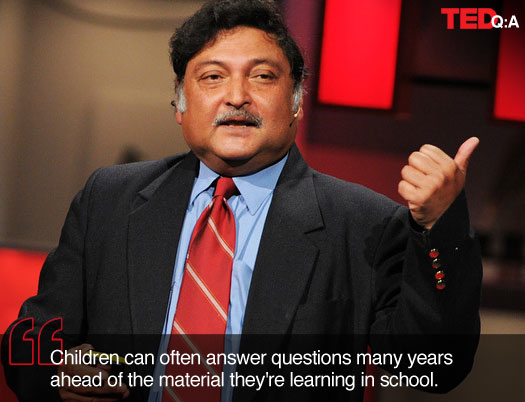
Experiments show that children in unsupervised groups are capable of answering questions many years ahead of the material they’re learning in school. In fact, they seem to enjoy the absence of adult supervision, and they are very confident of finding the right answer. Ultimately, they retain the learning effortlessly and for years, much longer than what we see with rote memorization of facts and figures.
What are the barriers that stand in the way of its widespread adoption?
The existing Victorian system of education was created to mass-produce identical human beings, mainly to serve an aristocracy, and, in modern times, an industrial elite. Governments find it difficult to move away from this model, because it has worked. But in a tech-driven knowledge economy this method is not needed anymore, and it will not serve us. But too often we see that teachers and educational administrators feel threatened by self-organized learning. They, therefore, think it is not learning at all.
Does the idea of self-organized learning work better with today’s child, who is often highly wired and making a wide range of online choices each day?
Yes, it does. Right now, we have a generation of children 16 years old or younger who have never known a world without many of the connecting technologies that we take for granted and rely on heavily. How do these devices affect, and even improve, how we absorb information? Self-organized learning would not work at all without the Internet. Educationists have suggested this type of instruction as a method for years, but the resources were not there until recently. Now, with the Internet, we have the means and the capabilities to watch self-organized learning flourish. It’s a very exciting time.
Beyond the Hole in the Wall: Discover the Power of Self-Organized Learning is part of the TED Books series, which is available for the Kindle and Nook as well as on Apple’s iBookstore.
Comments (17)
Pingback: L’actualité pédagogique et du monde de la formation #10 | FormaVox - Interactive Trainings & Events
Pingback: FERN (HEARING) VOICES |
Pingback: L’actualité pédagogique et du monde de la formation #10
Pingback: TED Blog: How Can We Teach Our Kids To Be Smarter And More Creative? | My Blog
Pingback: Novo Livro TED pergunta: Podemos alterar a forma como ensinamos nossos filhos, os fazem mais inteligentes, mais criativos? « Curiosidades na internet
Pingback: Self-Organized Learning | Belajar MY Math
Pingback: NCN Articles of Interest: 1/27/2012 « National Creativity Network
Pingback: Technology in Education | jksthoughts
Pingback: Self-Organized Learning Environment | jksthoughts