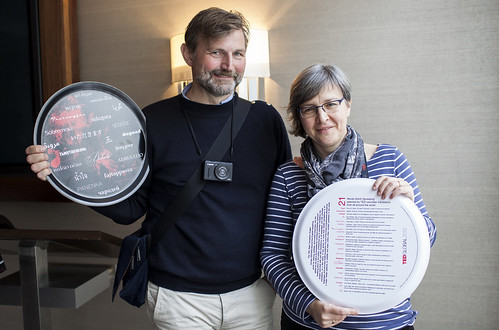
TED translators Dick Lundgren and Els De Keyser with the “21 untranslatable words” tray, at the Open Translation Project workshop before TEDGlobal 2012, June 24, 2012, Edinburgh, Scotland. Photo: Ryan Lash
On the weekend before TEDGlobal began, 22 volunteer translators converged from around the world to talk all day about translating TEDTalks. Among them, these 22 volunteers have translated more than 3,000 TEDTalks — part of a project to share TED in 88 languages and counting.
To celebrate, designer Dick Lundgren (who’s also a TED translator) made up this cool tray, covered in “untranslatable” words from 21 languages. The full word list (with definitions) is below …
21 Words Worth Spreading
Dutch:
pretoogjes: ‘fun-eyes,’ the eyes of a chuckling person
who is up to
some benign mischief
ˈprɛto:xjəs
Polish
bakalie: any dried fruit, nuts, and candied citrus peel used in baking or added to ice cream
baˈkaljɛ
Croatian
milozvučan: having a voice that sounds nice and sweet
milozʋutʃan
Serbian
мерак: pleasure derived from simple joys, such as spending time feasting and merrymaking
mɛ̌raːk
Norwegian
dugnad: a planned (semi-)volunteer work session in/for a community or local interest group
du:gnad
Spanish
sobremesa: the time spent after lunch or dinner, talking to people you shared the meal with
so.bre.mé.sa
French
savoir-être: knowing-how-to-be, soft skills, the relational equivalent of savoir-vivre
savwarˈɛtr
Czech
panenka: a trick to confuse your opponent, named after Panenka’s surprising penalty in the 1976 European Championship
ˈpanɛŋka
Bulgarian
чародей: an arch-Bulgarian wizard, magician, sorcerer, necromancer, enchanter
ˈt∫arodei
Russian
тьмутаракань: the back of beyond, the middle of nowhere, the underdeveloped depths of the country
tjmʊtərəˈkanj
Greek
φιλότιμο: ‘friend-honour,’ to respect and honour your friends, the quintessence of Greeks
fiˈlɔtimɔ
Italian
fattapposta: ‘made-on-purpose’: passkey of Italian conversation, can mean any object, especially when clarified by a gesture
fat.tapˈpɔsta
Thai
tɕāj: sincere kindness and willingness to help others, even before they asked, without expecting something in return
náːm
Japanese
いただきます: a phrase to start a meal with gratitude to all: from cooks and farmers to lives to be eaten
itadakimasu
Swedish
mångata: a roadlike reflection of the moon in the water
moːnɡɑːta
Klingon
Qapla’: “Success” or “good luck” often used as an exclamation or in parting (“farewell”)
qχɑpˈlaʔ
Latin
aemulatio: Roman alternative to plagiarism: to show respect for literary predecessors by delivering an improved version of their work
aimuˈlaːtiɔː
Arabic
mo:ru:ɐ: the peak of manhood, a mixture of bravery and kindness
mo:ru:ɐ
Chinese
yù: jade, a five-stroke character representing five virtues: benevolence, righteousness, bravery, wisdom, trustworthiness
yù
Armenian
χatʃkɑɹ: ‘cross-stone’, a carved, memorial stele bearing a cross
χatʃkɑɹ
Urdu
goya: a contemplative “as-if” which nonetheless feels like reality
goya
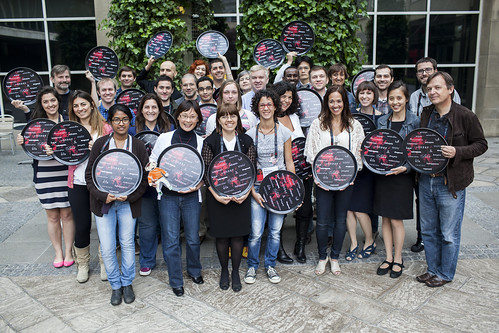
22 TED translators, plus TED staff, pose with their “21 untranslatable words” platters during the Open Translation Project workshop before TEDGlobal 2012, June 24, 2012, Edinburgh, Scotland. Photo: Ryan Lash
Comments (26)
Pingback: Cualacino?! culaccino!… | quasi.
Pingback: Word of the Day Wednesday: Komorebi (コモレビ) | EF Foundation for Foreign Study Mid-Atlantic
Pingback: 21 untranslatable words | urduwallahs
Pingback: Meet the translator: Els De Keyser, who brings you talks in Dutch | Krantenkoppen Tech
Pingback: Ten Brilliant ‘Untranslatable’ Words
Pingback: Ten Brilliant ‘Untranslatable’ Words
Pingback: Lost in Translation: 10 Words that are Untranslatable to English | dakwak's blog
Pingback: Linguistics: What are some lexical gaps? - Quora