Fuel without fossils
Jonathan Trent set out to understand if there was a way to develop biofuels that would compete with fossil fuels, but not compete with agriculture.
His proposed solution is extraordinary: Make an enclosure with plastic and let algae grow in sunlight in the ocean, taking in wastewater from cities. Generated heat will be dissipated into the surrounding water, and the products of the algae could be used in many projects. You would have to build a lot of such growing pods, but the benefits are tremendous.
This is the basic idea behind OMEGA, Offshore Membrane Enclosures for Growing Algae, an audacious project started by Trent and his colleagues.
How does it work?
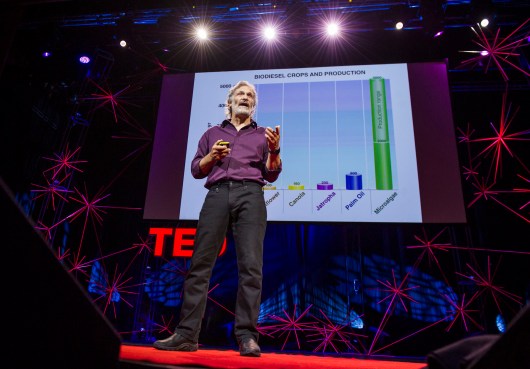
First, why use micro-algae? Micro-algae could contribute between 2,000 and 5,000 gallons of fuel per acre per year (as opposed to soybean’s 50 gallons).
Why build it offshore? There’s no choice. Our coastal cities cover large areas, and release their waste offshore. That waste is the food for algae.
What will it look like? The wastewater goes into a floating bioreactor. Sunlight provides energy to grow, waves provide energy for mixing, the water is the temperature regulator. The algae produce biofuels, fertilizer and food.
How do the algae breathe? Having a bunch of algae circulate in a plastic bag is, well, “a bit like putting your head in a plastic bag.” So they added a bubbler to provide CO2 to the system. (Algae breathe in CO2 and expel oxygen.) The column of CO2 has a nice side effect, in the fact that the algae settles in the bottom, which gives a way to harvest it with a net.
The system can recover water from the initial wastewater, and will itself become an attraction for sea life and become a floating reef. Finally, since it’s offshore, it can also be used for aquaculture and grow food.
Yeah.

What have they done?
Trent and his group have established a lab in Santa Cruz, a facility for research in San Francisco, and a field site in Monterey Bay.
In the research progress, they’ve made a lot of designs that don’t work. (The 10,000 ways to do it wrong, as per Thomas Edison.) But they’ve found ways to make the micro-algae grow. They’ve made prototype floating bioreactors. There’s a 30-gallon model in Santa Cruz, and 450 gallons in San Francisco.
The test system in Monterey gives the team a way to study how it interacts with marine life. In particular, a sea otter was very interested. Says Trent, “We wanted to hire this sea otter to clean the surface of this thing … but that’s for the future.”
The current idea is to produce a floating farm in the San Francisco Bay. It would be 1,280 acres offshore, or about 1% of the bay, and would produce just over 2 million gallons. Around the world there are lots of possible locations for floating farms, and with the coming sea level rise there will be more, jokes Trent, to nervous laughter from the audience.
“Let me tell you, it’s not going to be easy,” he says. “But we don’t have a lot of time.” The economics are difficult to make work, unless, says Trent, you think of it as an integrated system — to treat wastewater, generate liquid fuel, generate solar power, grow food with aquaculture, and more. Even the plastic that encloses the pods can be recycled into plastic that is used in standard land-based farming.
“Long-term,” says Trent, “I have great faith in our collective, and connected ingenuity. I set out to find a pathway to innovative production of sustainable biofuels. I found what’s really required is integration more than innovation.”
For more, see Trent’s TEDx Talk from TEDxSantaCruz >>
Photos: James Duncan Davidson
Comments (4)
Pingback: TEDxSantaCruz 2012 Press Coverage « TEDxSantaCruz