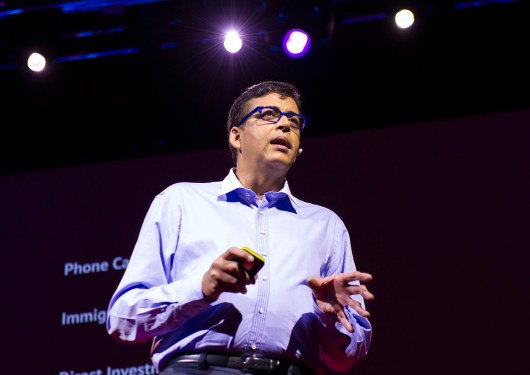
Pankaj Ghemawat is the author of Global 3.0: Global Prosperity and How to Achieve It, and he takes the stage to ask an important question: Just how global are we really?
It’s not a new question, of course. It’s one that David Livingstone first floated back in the 1850s, and one that’s been popularized by writers such as Thomas Friedman. But Ghemawat, who notoriously wrote the article The World Is Not Flat, wants us to take a look at some data. He asks the audience: What percentage of all voice calling minutes do you think were international? The answer is 2% (as much as 7% with internet telephony). The audience coos, clearly not expecting the number to be that small.
How about the number of first-generation immigrants? 3%. More “huh”s. Or how much direct investment was foreign? Not quite 10%. The audience gets the gist now, and here’s one last stat. Exports as percent of GDP, according to official statistics around the world, average more than 30%. “But,” he says, “there’s a big problem with the official statistics. If a Japanese component supplier ships something to China to be slotted into an iPod and then it’s shipped to the U.S., it counts multiple times.” It helps to have friends in high places: Ghemawat asked his friend Pascal Lamy, director of the World Trade Organization, to estimate this figure excluding the double-counting and triple-counting. Lamy guessed the figure would be under 20%.
“Clearly, apocalyptically minded authors have overstated the case” for globalization, says Ghemawat. The thing is: many of us seem to agree that the world is flat. “Even though I’m an economist, I find this a pretty large error,” says Ghemawat drily. “This is globaloney.”
Ghemawat didn’t mean to become the evangelist for this way of thinking. He tells us a story of being interviewed for Indian television in Mumbai. “The first question the interviewer asked me was, ‘Professor Ghemawat, why do you believe the world is still round?’ I started laughing; I hadn’t come across that formulation before and I thought I really needed a more coherent response,” he says. “But what I can’t capture for you is the pity and disbelief with which the interviewer asked the question. It’s very cool to talk about the world being one. If you raise questions about that formulation, you are considered a bit of an antique.” This, he says, was a spur to action.
Given the dearth of thoughtful debate about the topic and the peer pressure to take a trendy position, Ghemawat was also inspired by what he calls “techno-trances.” He acknowledges this might be a touchy subject for a TED audience, but “this is nothing more than an analogy with a well-known finding that if you listen to techno music for a long time it does something to your brainwave activity.” That’s similar with the belief that technology will win out over all. Ghemawat clearly doesn’t agree. So he looked at Facebook. After all, Facebook lowers the barrier to friendship. We should all have friends everywhere now. Right?
Wrong. Typically, up to 15% of your friends are from another country than the one in which you live. “Not negligible,” he acknowledges. “We don’t live in an entirely local or national world, but that’s far from the 95% level you might expect.”
So does all this matter? “Is globaloney just a harmless way to get people to pay more attention to global issues?” he asks. “I’d suggest globaloney can be very harmful to your health.” He has two points to make:
First, recognizing that the glass is only 10-20% full helps us to see that there is plenty of room for additional gains. “If we thought we were already there, there’d be no point in pushing harder,” he says. “Being accurate about how limited globalization levels are is critical to noticing that there might be room for something more that would contribute further to global welfare.”
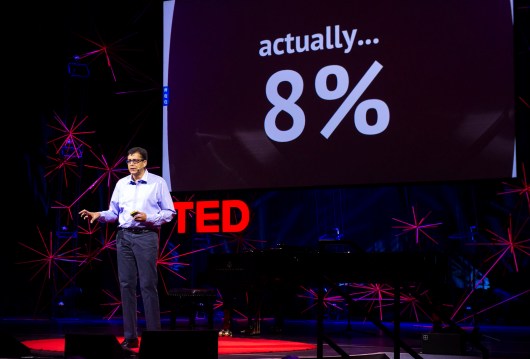
“Secondly, avoiding overstatement is very helpful, because it reduces and in some cases reverses some of the fears people have about globalization.” For example, where French people guess that immigrants make up 24% of France’s population, the figure is actually 8%. “Maybe realizing that the number is 8% might help cool some of the superheated rhetoric we see around the immigration issue,” he says.
Meanwhile, Americans guess that foreign aid accounts for more than 30% of the U.S. federal budget. The audience laughs. They know what’s coming … the reality is about 1%. Ghemawat suggests that when some people hear the real number, they’re encouraged to invest more. And this, Ghemawat says, is the critical point. By being accurate, by aiming for even small changes, we can have an enormous effect, quickly. “Given how closed we are,” he concludes, “even incremental openness could make things dramatically better.”
Photos: James Duncan Davidson
Comments (16)
Pingback: Even in a Digital World, Globalization Is Not Inevitable - Big Sky Headlines
Pingback: Even in a Digital World, Globalization Is Not Inevitable – Wonk Wire
Pingback: Even in a Digital World, Globalization Is Not Inevitable – Harvard Business Review | Best electronic online
Pingback: Is Globalization Dead? – Hult BENTO
Pingback: tom-sauer.de » TED Blog | Globalization and Globaloney: Pankaj Ghemawat at TEDGlobal 2012
Pingback: The Limits of Globalization | Imperial & Global Forum
Pingback: Global Connectedness Index 2012: Confirming Globaloney | The Global Fool
Pingback: The Big Philosophical Questions: In what ways is the world still not flat? - Quora
Pingback: A World Not as Global as We Thought | Charting Paths in a Wider World
Pingback: Globalisation » Day of Archaeology
Pingback: Fixing our broken systems: TEDGlobal 2012 Day 2 recap | Indoor Digital Billboards
Pingback: Fixing our broken systems: TEDGlobal 2012 Day 2 recap | Krantenkoppen Tech