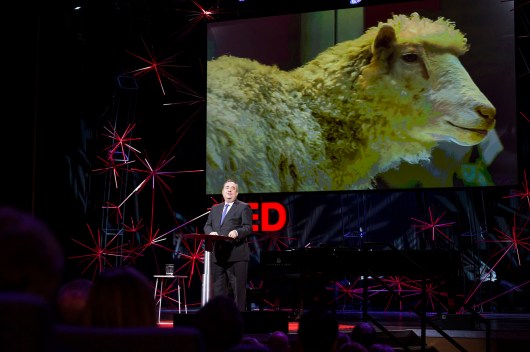
Alex Salmond is interested in the role of small countries in the world. And, “As the leader of a small country that’s had a big impact on the world, it’s something of a specialist subject of mine.” Indeed! Salmond was the First Minister of Scotland.
He points to a remarkable moment at the height of the recent protests in Trafalgar Square, London. One of the chants was “Long live Al-Jazeera.” They were talking about the importance of reporting, but the chant also served as an example of how a small country can have enormous impact. Al-Jazeera was founded in 1996 in Qatar, a country of just 2 million people. As an institution, it has survived to now become respected by more people on the planet than the BBC.
Small countries, says Salmond, can have an enormous impact: “Not because they’re big, but because they have big ambitions and bold ideas.”
The impact can range in size. In one school in Malawi, Scotland installed electricity, which was a cause of major celebration. That is not, as he says, as important as the Arab Spring, but for the schoolchildren themselves, it’s hugely significant. The Scottish government is now working to establish more schools across that country.
But there are also ways to make global impacts. Scotland, he says, has exerted a disproportionate effect on the world. Scots invented many things. In the National Museum of Scotland, in just one part of one room, there are: James Watt’s original steam engine, John Logie Baird’s first color television (in 1928!), the Nobel Prize that Alexander Flemming received for the discovery of penicillin, and Dolly the sheep.
“Are Scots more creative?” asks Salmond, rhetorically. No, and here’s the more likely answer: All this invention is due to the fact that Scotland was the first country to introduce free universal education.
Says Salmond, “That passion for innovation is still apparent today, and nowhere is it more apparent than in the field of renewable energy.” Scotland is the European center for offshore wind research, as well as having the largest center for wave and tidal energy testing. In fact, more than half the devices for harnessing wave and tidal energy in the world are found in Scotland. This isn’t pure altruism. It “reflects a determination and ambition born of enlightened self-interest.” Scots see renewables as an economic opportunity.
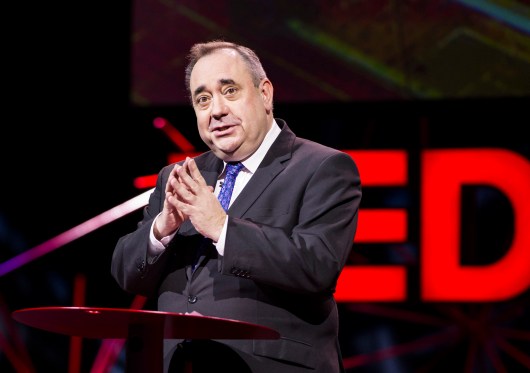
Many parliaments have developed policies to resist climate change. But in Scotland they passed a resolution commiting to bold steps, and they passed it unanimously — showing how this way of thinking cuts across the spectrum. They were also the first government in the world to establish a climate justice fund, with the idea that those who’ve benefited from the forces driving climate change should help less developed countries adapt to that change.
“Nations,” says Salmond, “can exert influence in the scale of their ambition, and not the size of their armies.”
In the first half of the last century, small nations had two problems: security and access to markets. Now, markets have opened, and security threats are from terrorism and network-based crime. All of that means that the disadvantages of small nations have been minimized, and they can use their natural strengths — such as the speed of decisionmaking — more effectively. Want proof? Here’s some: 11 of top 20 nations in the UN Human Development Index have populations less than 10 million.
Scotland as a nation has had a big impact to the world in the past, he believes it can make a big impact in the future. “As states across the planet are already showing, the size of a nation matters much less than the scale of its ambition, the strength of its ideas, and the vision for a better future.”
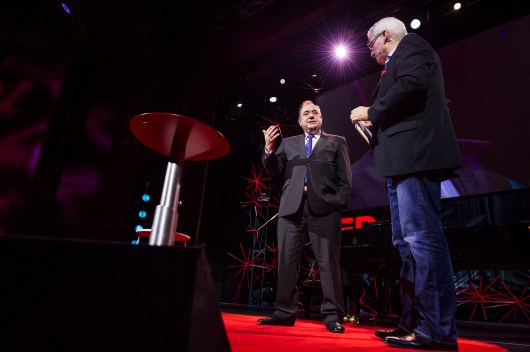
After the talk, host Bruno Giusanni comes on stage to ask a few questions about the Scottish roadmap to independence. This Q&A took place two years before Scotland held a referendum on the question of independence from the United Kingdom.
Q: “Why is now the time for independence? Why 2014?”
A: Because of the recent recession. The referendum is a chance for Scotland to “express its identity, and demonstrate its worth.”
Q: Giusanni points to polls showing many Scots don’t want full independence, but expanded powers. How will Salmond convince them?
A: Interestingly, the UK government seems determined not to offer more powers, which means that independence is more attractive. Plus, as he notes: “If you offer specifics… people say yes.” So his plan is to make the case for individual powers, and from that case, suggest that that means independence.
Q: How do you make the economic case, as opposed to the political one?
A: Persuasion and argument. But, Salmond insists, the argument for independence is fundamentally not economic. “No one is going to take better decisions for Scotland than the people of Scotland.”
On September 19, 2014—about two years after his talk—Scotland voted “no” to independence, by a margin of 55% to 45%. The day after, Salmond announced his intention to resign. “For me as leader my time is nearly over, but for Scotland the campaign continues and the dream shall never die,” he said.
This post was originally published on June 27, 2012. It was updated in September of 2014.
Comments (10)
Pingback: In A Changing World, Small Is Beautiful - National Collective - An open and non-party political platform for artists and creatives to engage with the Scottish independence campaign
Pingback: In a changing world, small is beautiful « North by Left
Pingback: The case for being opaque: Deyan Sudjic at TEDGlobal 2012 | Indoor Digital Billboards