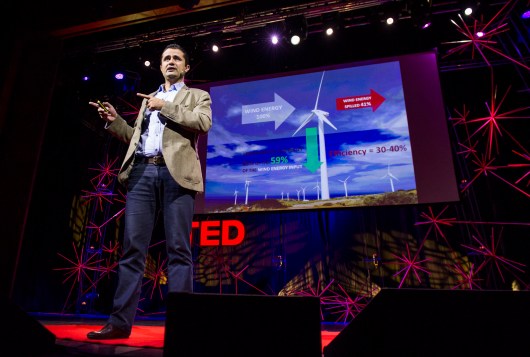
Hassine Labaied is here to talk wind. Specifically, wind power. “Wind is clean, free, perpetually renewable and widely distributed across the globe,” he says. “Yet the current main wind technology, the turbine, is still based on a windmill system.” And existing turbines are terribly inefficient: 70% of wind power is simply lost, while the devices are also expensive and unreliable.
Labaied’s solution is inspired by sails, not blades. He describes what he’s calling “Zero-Blade” technology. He shows video of a “dancing dish,” designed to convert the kinetic energy of wind to electricity.
He has some stats to share. By removing some of the most expensive components of a wind turbine, it is possible to slash costs by 50%. The system can store energy to be deployed at a later stage via hydraulic accumulators, solving a big problem with existing systems. And it’s efficient, able to capture twice as much kinetic energy as a conventional wind turbine. “The aerodynamic design and the motion enables it to literally swallow a big part of the wind,” he says lyrically.
Yes, there are still many questions to be answered, he acknowledges. But tests are promising and suggest that the system might be twice as efficient as the original system. “On top of that, it is bird-friendly, almost silent, and it offers a good visual integration into the landscape.”
Labaied concludes his short talk optimistically and poetically: “Some of you might think it’s too good to be true. but the history of human evolution has taught us that nothing is out of reach. The overwhelming majority of innovation came from places that are least expected,” he says. “Our dream is to take this innovation to the next level and to contribute to the global efforts to make this world a better and a cleaner place for the next generation.”
Photo: James Duncan Davidson
Comments (17)
Pingback: Blowing in the Wind: Using Wind Power to Cruise More Sustainably
Pingback: Invest carefully: wind energy innovations are rarely kosher | YES! to renewables
Pingback: Invest carefully; wind energy ‘innovations’ are rarely kosher | barnard on wind
Pingback: To Prevent Wind Turbines From Killing Birds, Add Blinds? | ccnew
Pingback: To Prevent Wind Turbines From Killing Birds, Add Blinds? « Music RSS
Pingback: Constructing kinetic worlds: the futuristic films of TED Fellow Kibwe Tavares | LiMiT
Pingback: “Instead of harvesting wind energy with rotating blades, the Saphonian uses a sort of round sail held in a frame. « SavePHP.org Pleasure House Point is 122 acres and can be preserved forever with your help. Thanks to VB City Council for voting
Pingback: A Wind Turbine Safe for Wildlife! | American Solar Energy Society
Pingback: Stuff We Need: Better Wind Turbines, Part II | Fish & Bicycles
Pingback: The Saphonian Wind Turbine Ditches Blades for a More Efficient and Less Expensive Design | Inhabitat - Sustainable Design Innovation, Eco Architecture, Green Building
Pingback: TED: Are there any TED talks that specialists in the field think are ridiculous / overstated / wrong? - Quora