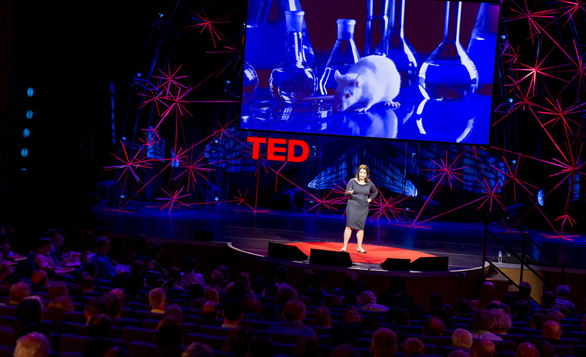
The way we test new drugs is broken, says Susan Solomon at TEDGlobal 2012. Below, several more speakers with ideas for fixing this system. Photo: James Duncan Davidson
The process for testing new drugs is clunky at best. As Susan Solomon reveals in her TED Talk, drug discovery on average takes 13 years, costs $4 billion, and has a 99% failure rate. Drugs are tested in the lab, then in animals, then in human trials that often aren’t big enough to be conclusive. (Human beings have a near infinite number of differences — a truly amazing thing, until different bodies start reacting in unpredictable ways to the same treatment.) As Roger Stein shares in his TED Talk, because of the incredible challenges inherent in this system, about 20 years of life-saving drugs sit in labs, untested.
Many TED speakers have shared intriguing ideas for streamlining, improving and rethinking the way we test pharmaceuticals. Below, watch seven talks with bold ideas that could potentially get medicines to people faster, and in forms that work better for their unique body composition.
 Susan Solomon: The promise of research with stem cells
Susan Solomon: The promise of research with stem cells
Susan Solomon: The promise of research with stem cellsSusan Solomon founded the New York Stem Cell Foundation (NYSCF) to give researchers a safe-haven to study stem cells, which she calls “our bodies’ own repair kits.” In this talk from TED Global 2012, Solomon shares how they are using a machine that creates stem cell lines — 2,500 of them by the end of the year. The idea is to eventually produce a comprehensive array of 25,000 stem cell lines — which act like avatars for a wide sample of people — that researchers would have access to as they develop new drugs. |
 Roger Stein: A bold new way to fund drug research
Roger Stein: A bold new way to fund drug research
Roger Stein: A bold new way to fund drug researchInvesting in a drug — say, a potential treatment for cancer — is a financially risky thing. Which means that far too many drugs simply can’t get the funding to go to trials. At TED@StateStreet, financial engineer Roger Stein shares an ingenious idea: pool hundreds of drugs into a fund, the same way you would with mortgages, and thus decrease the risk. In this personal talk (Stein’s father has cancer, but is doing much better thanks to an experimental drug trial), Stein shows how this could bring investors and venture capitalists running, and could create a new revenue stream for medical research. |
 Nina Tandon: Could tissue engineering mean personalized medicine?
Nina Tandon: Could tissue engineering mean personalized medicine?
Nina Tandon: Could tissue engineering mean personalized medicine?TED Fellow Nina Tandon has engineered human heart tissue in the lab that actually beats. Though it may sound like a plot from a sci-fi film, someday, surgeons could use this tissue like mechanics use spare parts in cars. But there is another potential use — lab-created tissue could be used to test pharmaceuticals. In this talk from TEDGlobal 2012, Tandon explains that induced pluripotent stem cells — cells that have been tricked into acting like embryonic stem cells — can be grown in skin tissue, brain tissue, heart tissue, you name it. This means that a model of a person’s body could be stored on a chip and, from there, clinical trials could be conducted on these chips. Once a drug is approved, engineered tissue could allow doctors to test exactly how different drugs would work for a specific patient. Tandon envisions a future of personalized medicine, where patients try on treatments the way they do a pair of jeans. |
 Ben Goldacre: What doctors don't know about the drugs they prescribe
Ben Goldacre: What doctors don’t know about the drugs they prescribe
Ben Goldacre: What doctors don't know about the drugs they prescribe
Ben Goldacre: What doctors don’t know about the drugs they prescribeIn this talk from TEDMed 2012, Ben Goldacre shares a scary fact of our medical testing apparatus — that a large number of the trials conducted on any given drug never get published, meaning that doctors do not have all the information necessary when they write prescriptions. Goldacre sounds a warning bell that medical research shouldn’t be conducted by companies hoping to turn profit from drugs, and that there should be no option not to publish the results of any medical trial. |
 John Wilbanks: Let's pool our medical data
John Wilbanks: Let’s pool our medical data
John Wilbanks: Let's pool our medical data
John Wilbanks: Let’s pool our medical dataWhen signing on for a medical trial, participants are given “informed consent,” a document that carefully lays out the scope and risks of the research. It’s a great thing, intended to shield participants from abuse and trickery, but has one unfortunate consequence. Because of informed consent, medical data has become siloed. In this talk from TED Global 2012, John Wilbanks shares an idea for pooling medical data and making it available to anyone wishing to test a hypothesis. |
 Geraldine Hamilton: Body parts on a chip
Geraldine Hamilton: Body parts on a chip
Geraldine Hamilton: Body parts on a chipOver the past 60 years, a startling trend has emerged — for every billion dollars spent on the research and development of new pharmaceuticals, fewer drugs are making it to the market. In this talk from TEDxBoston, Geraldine Hamilton shares how her lab is creating organs on a chip. These chips recreate the biochemistry of the body, meaning that cells are in the environment they thrive in, rather than placed in a petri dish or injected into an animal, and these chips could be linked together to form a “human on a chip.” These incredible chips could allow scientists to model diseases we don’t understand. They could help us get rid of animal testing, test the chemicals we use everyday to see how they actually affect the body, see how medications work in children and so much more. It’s an inspirational look at a new approach to medicine. |
 Jay Bradner: Open-source cancer research
Jay Bradner: Open-source cancer research
Jay Bradner: Open-source cancer researchJay Bradner’s lab made an exciting medical discovery — a molecule that might inform cancer cells. But instead of patenting it, they published the finding and even mailed samples out to other labs. At TEDxBoston 2011, Bradner shares what he sees as a flaw in our current medical research system — that information that could benefit us all can be claimed and owned. |
Comments (7)
Pingback: 9 old drugs that learned new tricks: The head of the National Institutes of Health shares medicines that turned out to have multiple uses | Krantenkoppen Tech