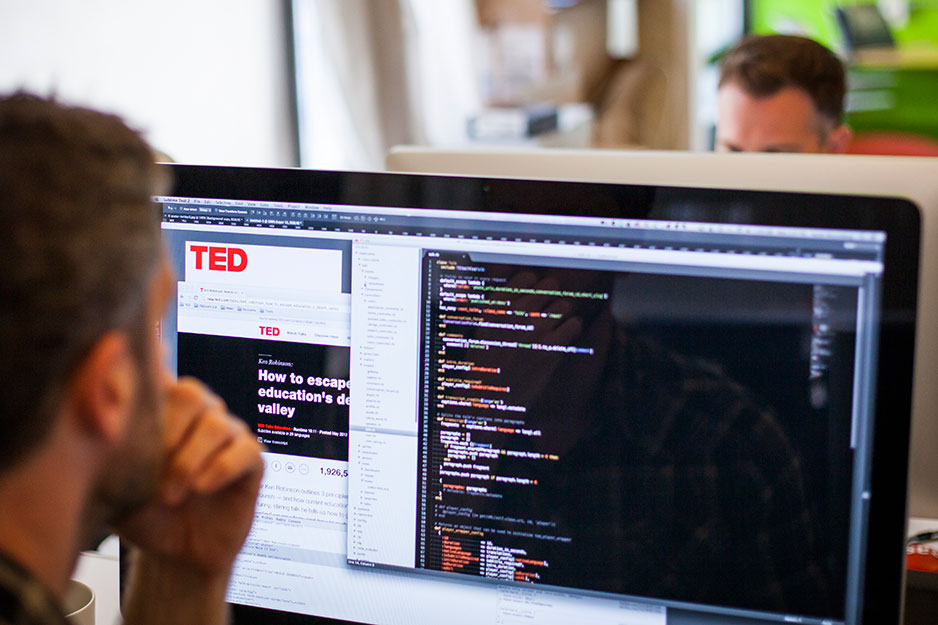
 Teens, tweens and kids are often referred to as “digital natives.” Having grown up with the Internet, smartphones and tablets, they’re often extraordinarily adept at interacting with digital technology. But Mitch Resnick, who spoke at TEDxBeaconStreet, is skeptical of this descriptor. Sure, young people can text and chat and play games, he says, “but that doesn’t really make you fluent.”
 Mitch Resnick: Let's teach kids to code
Fluency, Resnick proposes in this TED Talk, comes not through interacting with new technologies, but through creating them. The former is like reading, while the latter is like writing. He means this figuratively — that creating new technologies, like writing a book, requires creative expression — but also literally: to make new computer programs, you actually must write the code.
Mitch Resnick: Let's teach kids to code
Fluency, Resnick proposes in this TED Talk, comes not through interacting with new technologies, but through creating them. The former is like reading, while the latter is like writing. He means this figuratively — that creating new technologies, like writing a book, requires creative expression — but also literally: to make new computer programs, you actually must write the code.
The point isn’t to create a generation of programmers, Resnick argues. Rather, it’s that coding is a gateway to broader learning. “When you learn to read, you can then read to learn. And it’s the same thing with coding: If you learn to code, you can code to learn,” he says. Learning to code means learning how to think creatively, reason systematically and work collaboratively. And these skills are applicable to any profession — as well as to expressing yourself in your personal life, too.
In his talk, Resnick describes Scratch, the programming software that he and a research group at MIT Media Lab developed to allow people to easily create and share their own interactive games and animations. Below, find 10 more places you can learn to code, incorporating Resnick’s suggestions and our own.
- At Codecademy, you can take lessons on writing simple commands in JavaScript, HTML and CSS, Python and Ruby. (See this New York Times piece on Codecademy and other code-teaching sites, for a sense of the landscape.)
. - One of many programs geared toward females who want to code, Girl Develop It is an international nonprofit that provides mentorship and instruction. “We are committed to making sure women of all ages, races, education levels, income, and upbringing can build confidence in their skill set to develop web and mobile applications,” their website reads. “By teaching women around the world from diverse backgrounds to learn software development, we can help women improve their careers and confidence in their everyday lives.”
. - Stanford University’s Udacity is one of many sites that make college courses—including Introduction to Computer Science—available online for free. (See our post on free online courses for more ideas.)
. - If college courses seem a little slow, consider Code Racer, a “multi-player live coding game.” Newbies can learn to build a website using HTML and CSS, while the more experienced can test their adeptness at coding.
. - The Computer Clubhouse, which Resnick co-founded, works to “help young people from low-income communities learn to express themselves creatively with new technologies,” as he describes. According to Clubhouse estimates, more than 25,000 kids work with mentors through the program every year.
. - Through CoderDojo’s volunteer-led sessions, young people can learn to code, go on tours of tech companies and hear guest speakers. (Know how to code? You can set up your own CoderDojo!)
. - Code School offers online courses in a wide range of programming languages, design and web tools.
. - Similarly, Treehouse (the parent site of Code Racer) provides online video courses and exercises to help you learn technology skills.
. - Girls Who Code, geared specifically toward 13- to 17-year-old girls, pairs instruction and mentorship to “educate, inspire and equip” students to pursue their engineering and tech dreams. “Today, just 3.6% of Fortune 500 companies are led by women, and less than 10% of venture capital-backed companies have female founders. Yet females use the internet 17% more than their male counterparts,” the website notes.
. - Through workshops for young girls of color, Black Girls Code aims to help address the “dearth of African-American women in science, technology, engineering and math professions,” founder Kimberly Bryant writes, and build “a new generation of coders, coders who will become builders of technological innovation and of their own futures.”
While we’re at it: bonus! General Assembly offers a variety of coding courses at their campuses across the globe. Additionally, their free online platform, Dash, teaches HTML, CSS and Javascript through fun projects on a simple interface that is accessible from your web browser.
Comments (362)
Pingback: Learning to Code, Coding to Learn - Electronic BrainsElectronic Brains
Pingback: March 24th | infodon
Pingback: Collection of Links: Resources for Learning to Code | The Modern MLIS
Pingback: 10 places where anyone can learn to code | Katharinas skolblogg
Pingback: 10 places where anyone can learn to code | red rabbit skills services | skills development consultancy
Pingback: The Language of the Internet | Intercollegiate Review
Pingback: Everyone should learn to code | beYou media
Pingback: heystaceykay! | Entering the harrowing world of coding.
Pingback: 人人都該學程式設計 | TEDxTaipei
Pingback: 10 locuri in care poti invata programare | Digital Kids
Pingback: Getting Girls to Code, Develop and Engineer | CMS Radar
Pingback: teaching and learning code | Electronic Sculpture
Pingback: Visto nel Web – 64 « Ok, panico
Pingback: Friday Link Fest…* | rethinked…*
Pingback: Teknologeek.com » Sitios para Ayudar a Aprender a Programar Facilmente
Pingback: ¿No sabes programar? 10 sitios donde aprender ← José Luis Pérez Díaz
Pingback: Ako zacat programovat - Michal Maxo Maxian