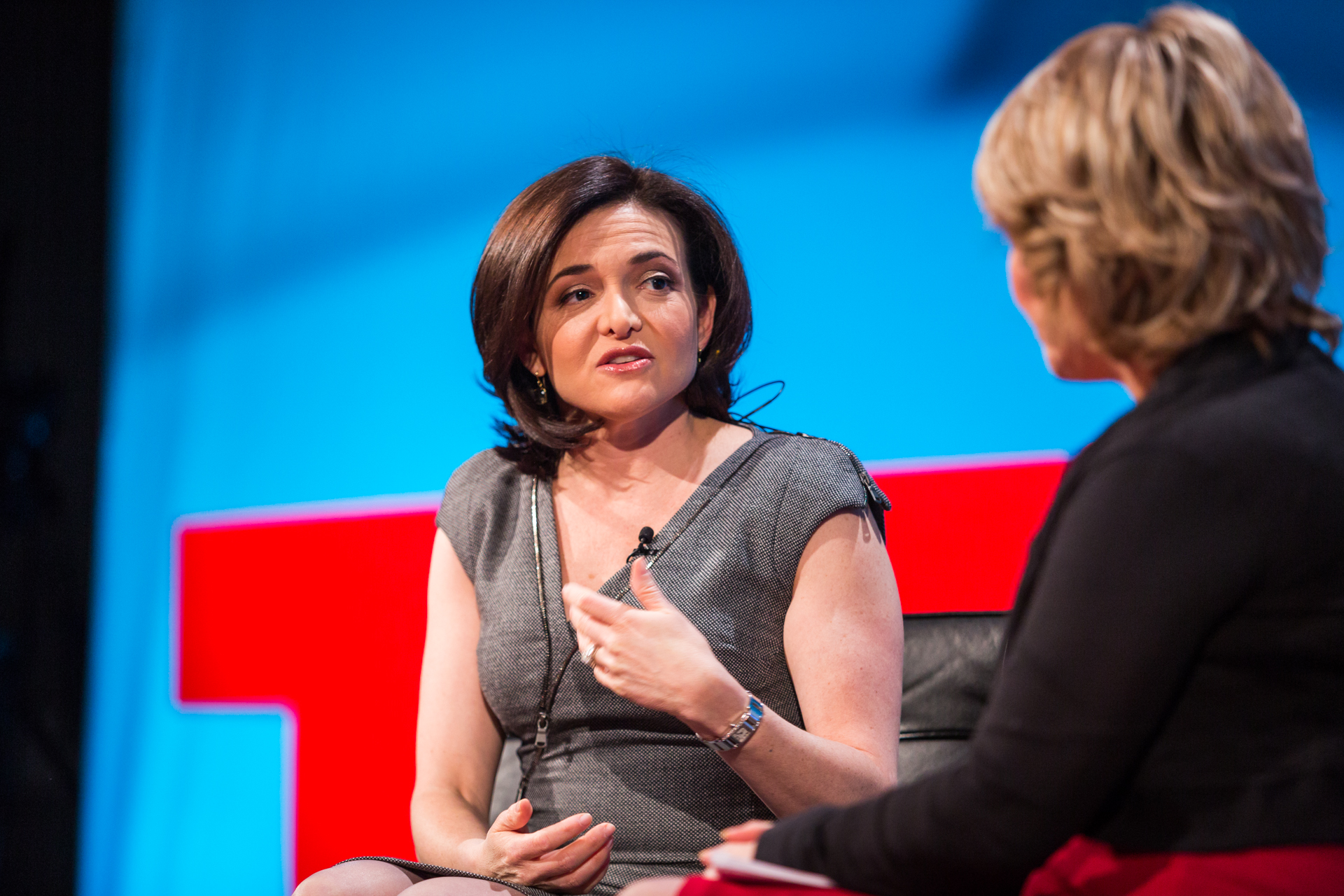
“That little girl’s not bossy. That little girl has executive leadership skills,” Sheryl Sandberg, left, tells TEDWomen co-host Pat Mitchell at TEDWomen 2013. Photo: Marla Aufmuth
“It’s nice to look out and see so many women. That’s not my norm,” Sheryl Sandberg comments drily as she takes her place onstage at TEDWomen 2013 at the SFJazz Center. She’s here to talk with co-host Pat Mitchell, in a Q&A follow-up to her incendiary 2010 TED Talk, given at a TEDWomen three years before.
First, Mitchell asks her to remember the process of putting together that talk. The subject matter wasn’t her first choice; in fact, Sandberg recalls that she’d had absolutely no intention of talking about anything so personal. “In the business world, you never talk about being a woman, because someone might notice you’re a woman,” she says. Friends told her that if she gave a “woman’s” talk, it would end her career. She realized she was scared. And then she realized that she had to face her fear. So she put aside the wonky stats and numbers she’d put into the talk she’d been planning to give, and she got on stage to focus on issues of women and leadership. “If you want to talk about getting more women in leadership roles, you have to talk about how hard it is,” she says frankly.
Things have moved fast since then. The overwhelming response to the talk, of course, led to the book Lean In, and Sandberg herself has become a lightning rod for feminist discussion about women and their role in the workplace. And while she is clearly proud of her place in the conversation, what’s interesting is her frank acknowledgement of her continued vulnerability. “I realized through the process [of writing Lean In] that I had to be more honest and open and tell my stories, about not feeling as self-confident as I should in so many situations. About my first and failed marriage. About crying at work. About feeling like I didn’t belong there, to this day.” To this day? Such ingrained feelings don’t disappear overnight, it seems.
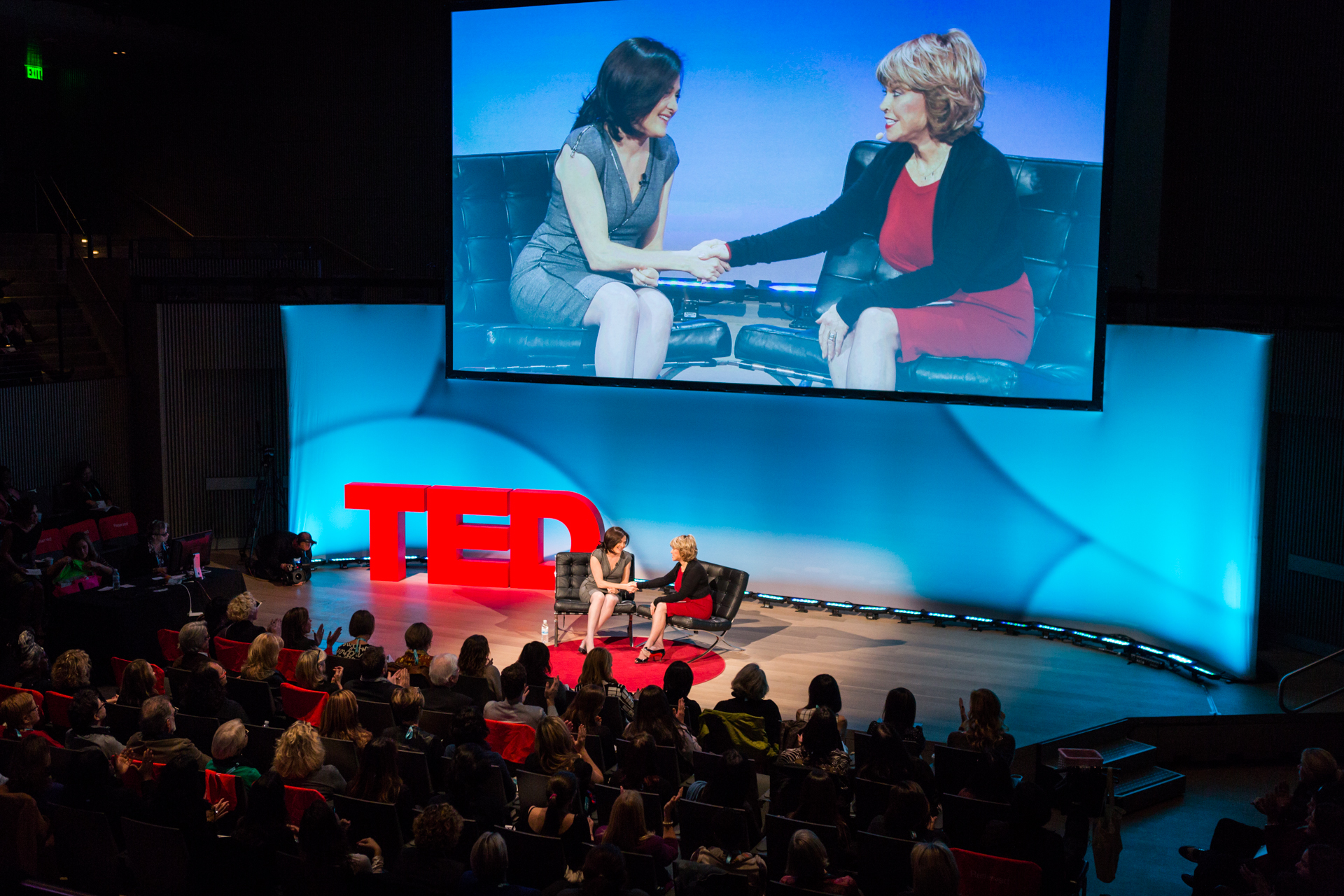
Sheryl Sandberg and Pat Mitchell shake hands on stage. Photo: Marla Aufmuth
Both the talk and the book have had extraordinary global effects. There’s more dialog about the issue, for one thing. But Sandberg is more interested in the change and action that are occurring. “Everywhere I go, CEOs, mostly men, say to me, ‘You’re costing me so much money,” she laughs — because women are speaking up and asking for what they feel they deserve. “To them I say, I’m not sorry at all,” she adds. She tells the story of the stay-at-home mom who saw the talk online. “She’d never had a corporate job, but the TED Talk inspired her to go to school and fight for a better teacher for her child,” she says. “I was fighting for my voice, and I found that other women could find their voice too.” She describes the “circles” who meet every month to discuss their lives and empower each other — there are now 12,000 such circles in 50 countries. She visited one such group in Beijing, full of women being told they were “left over” because they were not married. “We introduced ourselves and I said, ‘I’m Sheryl Sandberg and this is my dream.’ Then I started crying,” she says. “I do that.”
“The book is about self-confidence and equality. Everywhere in the world women need more self-confidence because the world tells us we’re not equal to men,” she continues. “I’ve never met a man who has been asked how he does it all.” The audience murmurs in appreciation. She asks women who’ve been asked this question to raise their hands: that’s a lot of women. “We assume men can do it all, and we assume women can’t. That’s ridiculous.”
But Sandberg is also clear-eyed that this is just a beginning. Cultures everywhere still dictate that men are the superior sex. They’re encouraged to be strong, assertive, to speak up. Women who do the same are “bossy.” That’s even happened to senior female executives at Facebook, she confesses, though she adds a promise: “We’re never going to do it again.”
And things aren’t changing quickly enough. “I try to say this strongly and I need to say it more strongly: the status quo is not enough,” she says. The latest census data show no movement in pay equality: at best, a woman is paid 77 cents to a man’s dollar, and that figure hasn’t improved since 2002. It’s not good enough. “We are stagnating in so many ways. We are not really being honest about that for so many reasons,” she concludes soberly. “It’s so hard to talk about gender. We shy away from ‘feminist,’ and it’s a word I think we have to embrace.” The crowd loves this so she rephrases in conclusion: “We need to get rid of the word ‘bossy’ and bring back the word ‘feminist.'”
Comments (56)
Pingback: Sheryl Sandberg Teams Up With Beyonce to Ban ‘Bossy’ | Modern Marketing World - Maximising Online Marketing Potential
Pingback: Sheryl Sandberg Teams Up With Beyonce to Ban ‘Bossy’ | CSAcademy - the blog
Pingback: Sheryl Sandberg Teams Up With Beyonce to Ban ‘Bossy’ | The Talkative
Pingback: Sheryl Sandberg Teams Up With Beyonce to Ban ‘Bossy’ | Social Media Marketing 24/7
Pingback: Sheryl Sandberg Teams Up With Beyonce to Ban 'Bossy' | testdemo.info
Pingback: We Need to Change Our Words to Change Our Worlds, Feminists | Christmas Celebration Ideas
Pingback: Book to Movie: Sony Acquires Film Rights to Sheryl Sandberg's Lean In
Pingback: 4 Women Who Inspired & Empowered gapmuse The Most In 2013 | gapmuse
Pingback: Must Reads: CNN’s Top Books of 2013 | Disorganized Trimmings
Pingback: Facebook’s Sheryl Sandberg Leans In And Helps ‘Boss Versus ‘Bossy’ Pantene Ad Go ViralSoviders Tech | Soviders Tech
Pingback: Lean In revisited: swap 'bossy' for 'feminist' | Women's Views on News
Pingback: TED Women Shows ‘Binders of Women’ Not Needed To Find Talented Tech Thinkers | SamacharYuG.Com
Pingback: TEDWomen događaj ili priče čiji je okvir usklađen sa stavom | PRototip
Pingback: A troupe of Rwandan drummers, odes to grandmas and laughing at cerebral palsy: A recap of TEDWomen 2013, Session 3 | Best Science News