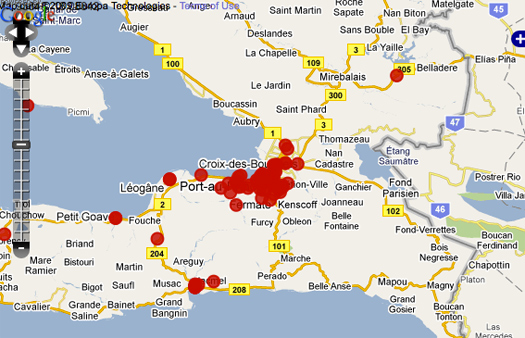
The TED Blog today spoke with Patrick Meier, who is part of the team at Ushahidi working to bring information about the Haiti earthquake crisis to Haitians (those inside and outside the country), the press, humanitarian relief workers, governments, and concerned people worldwide. (TED Senior Fellow Erik Hersman, TED speaker Ory Okolloh and TED Senior Fellow Juliana Rotich co-founded the organization.)
Visit Ushahidi’s Haiti site at http://Haiti.Ushahidi.com/ >>
Talk about you and your team’s immediate response to the earthquake in Haiti.
I found out about the earthquake around 7pm. I immediately contacted David Kobia, our director of technology development. Within half an hour we had a basic Ushahidi install for Haiti out.
We then collaborated with a number of our colleagues within the Ushahidi family, especially the International Network of Crisis Mappers, which Ushahidi co-founded and launched in October of 2009. We’ve had probably 100 email exchanges with them since we learned of the crisis. They’ve been absolutely phenomenal. It’s a group of about 200 people who are specialists in technology and humanitarian response. There has been an incredible amount of information sharing on that website’s dedicated Google Group.
We had support from two fantastic individuals from UN OCHA Colombia. They happened to have used Ushahidi in an earthquake simulation exercise a few months ago. They were vital in identifying the necessary categories (or indicators) that you see on the Ushahidi deployment: shelters, damaged buildings, etc. They are disaster response experts and know a few things about earthquakes, so they took the lead directly on the admin side, with the rest of our Ushahidi tech team, in adding information.
So, between 7pm and midnight, we had a number of individuals helping to customize the website as much as possible. The following day we set up an international number (+447624802524) for individuals to start texting in information to the platform. We’ve also been helping to submit as many of the reports as possible. On last count, we’ve got 120 geotagged events from last 24 hours. We had a colleague from Digital Globe fast-track some high-resolution satellite imagery for the group as well.
The outreach of resources in the global community has been phenomenal.
What’s happening right now with your team — and what’s going to be crucial in the next 24-48 hours?
What we’re focusing on now at Ushahidi simply getting the information into the system. We’ve set up a situation room at the Fletcher School at Tufts University. We’ve got about a dozen people now — probably a dozen more coming in in the next hour or two — combing the news and the Twitter feeds from individuals who are inside Haiti right now and tweeting on a regular basis. We’re mapping that information as quickly as we possibly can, because we know we’ve got a lot of folks inside Haiti who are looking at the website to get information. We expect a lot more information to come back in as the cell-phone network comes back online.
We’re mainly in the mode of crowd-sourcing the filter for the information that’s coming in. We have a fantastic team of Fletcher School graduate students who are sharing their time. It’s interesting because it’s a little quiet — everybody’s too busy to talk, crunching away, adding information as quickly as possible to the Ushahidi platform. We’re trying to gather pictures, video footage, you name it.
We’re also working with the US State Department to get us a short code that can be used locally.
It looks like you’re seeing a lot of pickup in terms of people on the ground, and other organizations, using the platform.
We’ve gotten a lot of traction already, but we can still scale it up several-fold. Others such as the Clinton Foundation have helped us get some visibility tweeting at the UNDP and a few other sources. It goes without saying that leveraging the TED network will be absolutely phenomenal to get the word out.
And what do you hope to see as this progresses?
The more data that’s available, the better.
Right now, that data happens to be on the Ushahidi platform. It’s available for anybody to take. We’ve got RSS feeds, we’ve got an open API; people can just scrape that information right off and do whatever they need to do with it. We’re hoping that they also contribute information, so that we have at least one go-to place that people can visit to find what they need. Ushahidi is the one main repository.
We simply need to get this information to as many people on the ground in Haiti as possible — that they know about Ushahidi, that they know the short code (when we have it), that they know that humanitarian response teams are monitoring it in order to form their operational responses.
About Ushahidi:
Ushahidi, which means “testimony” in Swahili, is a website that was initially developed to map reports of violence in Kenya after the post-election fallout at the beginning of 2008.
Ushahidi later shared its code with a group in South Africa that used it to map incidents of xenophobic violence. Later, an alpha version was deployed to the DR Congo for testing. Other major deployments included Al Jazeera during the War on Gaza, Vote Report India (to monitor the recent local elections) and Pak Voices (to map incidents of violence in Pakistan).
Visit Ushahidi’s Haiti site at http://Haiti.Ushahidi.com/ >>
Also see the Haitian Earthquake Registry of missing persons >>
Comments (8)
Pingback: 7th International Conference of Crisis Mappers - Celina Agaton
Pingback: The Civilization Starter Kit « Only Ed
Pingback: CrowdMapping the Chicago Blizzard « News Apps Blog
Pingback: Ideas for Future TEDxManhattanBeach Events | TEDxManhattanBeach