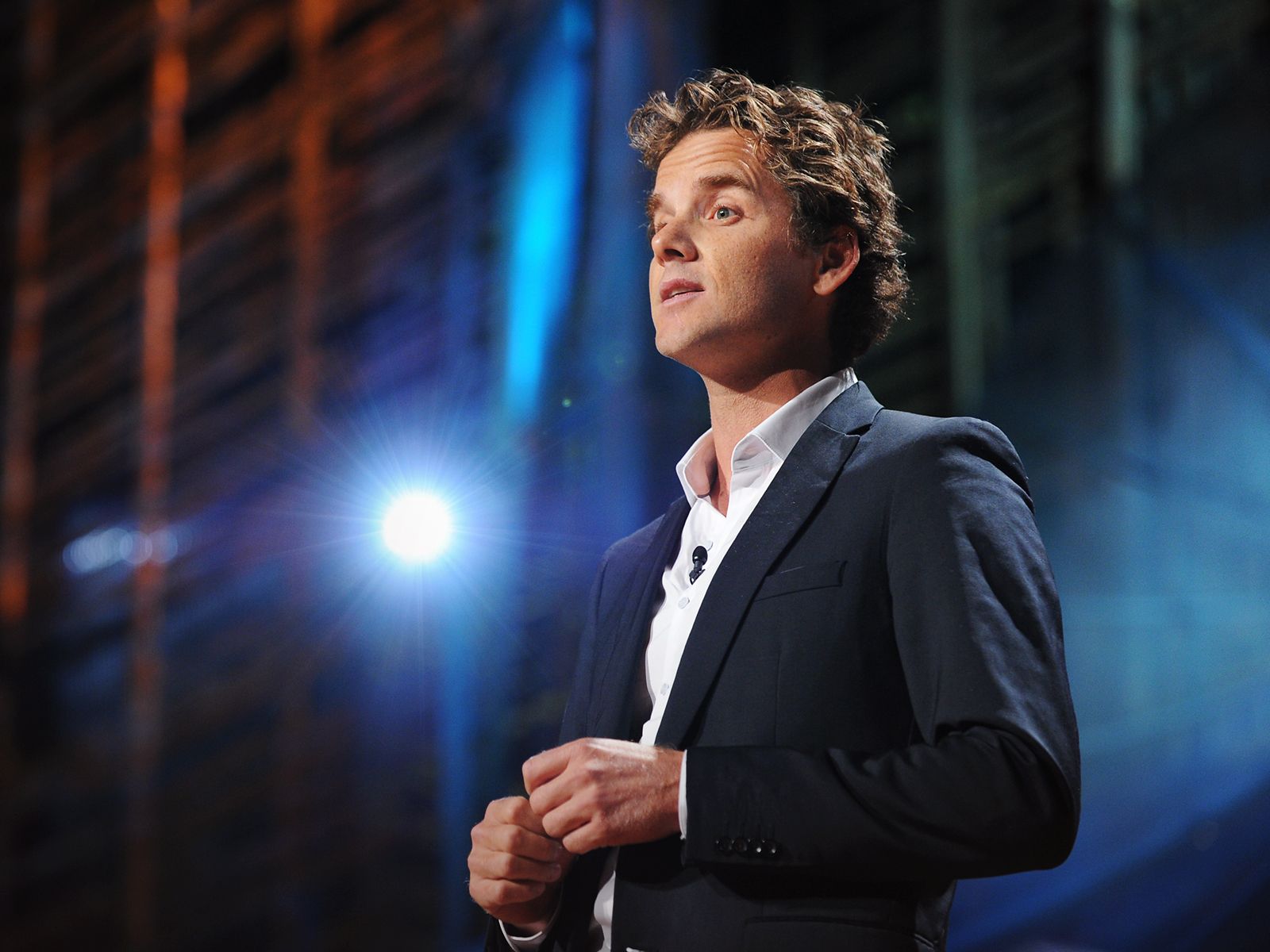
We all know the arguments that being vegetarian is better for the environment and for the animals — but in a carnivorous culture, it can be hard to make the change. Graham Hill has a powerful, pragmatic suggestion: Be a weekday veg. (Recorded at TED2010, February 2010 in Long Beach, CA. Duration: 4:04)
Read more about being a weekday veg >>
Watch Graham Hill’s talk on TED.com, where you can download this TEDTalk, rate it, comment on it and find other talks and performances from our archive of 600+ TEDTalks.


Pingback: | The Weekday Vegetarian"Long/ Live/ the…" | A blog by Marc Hummel | Philadelphia, PA
Pingback: Living the Life of a Weekday Vegetarian: A 12-Step Program | BizNax
Pingback: Living the Life of a Weekday Vegetarian: A 12-Step Program : Living Green Magazine
Pingback: 12 Tips to Becoming A Weekday Vegetarian. | elephant journal
Pingback: 12 Tips To Become A Weekday Vegetarian « L'artichaut
Pingback: Plant Based Eating | gingersneezes
Pingback: Behind the Mystery of Cheese « Green Pea Pod
Pingback: What’s the beef with Beef? « Advocacy Think Tank
Pingback: Alastair's Blog
Tushar mehta commented on Mar 23 2011
Hello Graham,
Thanks for the TED video about being a week end vegetarian. Though not not many of us could compare with the power of Oprah’s veggie talks, I really did enjoy it and feel that it will open many minds to the idea of vegetarian diet. It was nice that you brought out the trio of compassion, health, and eco friendliness.
Regarding your words about the sustainable eating of fish, I have a comment. I believe that we have to be very careful about the notion of sustainable fish eating. If even a small percentage of fish eaters, let’s say 5-10% of fish eaters in the world, switched to “sustainable fish”, would they still be sustainable?
According to the UN Food and Agricultural Association, the world total for capture and aquaculture of fish, mollusks, and crustaceans was a total of 141 million metric tonnes. The amount of sea creatures that are being eaten has grown every year since. If 5-10% of this number would entail the eating of 7-14 million metric tonnes of sustainable seafood. Would those species and ecosystems still be safe? What if we ate 25% from these sources. As seafood consumption grows, this will endanger the “sustainable” choices, without providing much relief to the species and ecosystems that are already in danger.
Please also note that marine omega 3 fatty acids/oils, that we are so obsessed with these days, come originally from seaweed. As small creatures eat seaweed and algae, they become part of bodies. As such they move up the food chain as fish consume each other. However, there are toxins that bioaccumulate as fish burn the fats for energy, but the PCB, dioxins, methyl-mercury, and furans remain behind in the bodies. Hence there may be a health benefit of the oils, but there is a definite toxic effect. Now there is actually overgrowth of seaweek and algae in the millions of tonnes, due to things like phosphate pollution. Omega 3 can be harvested directly from the plentiful seaweed for our priviledged consumption, without making a big dent in the amout of seaweed in the ocean. This omega 3 source would be extremely low in toxins, an not have much impact on the oceans. Silk soya milk now has a box with omega 3′s that come from marine plants. Pretty smart.
Well Graham, take care and keep up the great work. Please try not to be too influenced by industry! Cheers.
Dr. Tushar Mehta MD CCFP
ftp://ftp.fao.org/fi/stat/summary/summ_05/default.htm
http://www.fao.org/fishery/statistics/en
Pingback: VeggieThursday NEW - For The Environment
Pingback: VeggieThursday NEW - For The Health
Pingback: Holy Cow! « Tastes Hastily Jotted
Pingback: The Weekday Vegetarian | "Long/ Live/ the…" a blog by Marc Hummel [Philadelphia].
anthony gusto commented on May 27 2010
I hate Math ever since but I’m not to idiot no to compute my earnings or staff or even my food. Specially when you are in diet you are counting the food that you ate.
Brian Botticelli commented on May 18 2010
RE: Jonathan Sloves
Math has never been my strong suit, however if 10 people ate 10 hamburgers and we took half the people and half the hamburgers, this would equate to 5 people eating 5 hamburgers. This leaves the other 5 not eating hamburgers, ie: half being vegetarians. Is this logic correct?
Jonathan Sloves commented on May 18 2010
At the very end of his talk, Mr. Hill says “if half of us ate half as much meat, it would be like half of us are vegetarians”. Not to be nitpicker, but my math says that 1/2 of 1/2 = 1/4, so if half of us ate half as much meat, it would be like 25% of us are vegetarians.
With that being said, this talk is about cognitive and behavioral restructuring. Personally, I am willing to start by committing to 1 day of being a vegetarian a week, and I will try to increase it from there. Good luck on the math!
Dylan Dahya commented on May 20 2010
Hello, good on you! Just to let you know he actually says “If all of us…”, it would be pretty embarrassing if he did get wrong though.
Johnny Sjöberg commented on Sep 16 2010
That would be true – if that is what he said – which it is not.
What he said was “If ALL of us ate HALF as much meat – it would as if HALF of us are vegetarians.”
Which is correct.