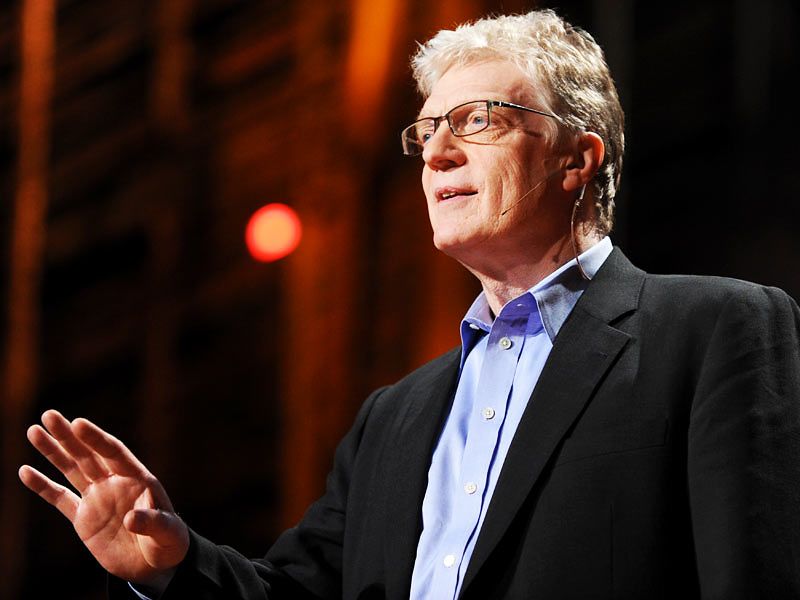
In this poignant, funny follow-up to his fabled 2006 talk, Sir Ken Robinson makes the case for a radical shift from standardized schools to personalized learning — creating conditions where kids’ natural talents can flourish. (Recorded at TED2010, February 2010 in Long Beach, CA. Duration: 16:48)
Watch Sir Ken Robinson’s talk on TED.com, where you can download this TEDTalk, rate it, comment on it and find other talks and performances from our archive of 700+ TEDTalks.


Pingback: “Великие учителя вдохновляют” | Accent Language Center
brian harris commented on Nov 9 2012
Yes, SPIRIT. Finally this man has wisdom so rare he needs to be heard by everyone especially the schools and all the children having their spirit torn out day after day.
brian harris commented on Nov 9 2012
im a survivor,barely, of the system. I am in teds debt. ted is so refreshing ,finally people are waking up. enjoy all.
Pingback: Video of the Week: The Learning Revolution | The Brainscape Blog: Learn How to Learn Faster
Pingback: Autentisk ledelse. Udfolde talent. Video af Ken Robinson.
Pingback: HR Tip #21: It’s all about Sesame Street… and Learning! « Groupon Jobs
Pingback: Groupon HR Tip #20 | from Groupon's UK Blog
Pingback: ken robinson | declanbartlett
Pingback: Martin Jacques: Understanding the rise of China @ Will Wide Web
Pingback: Stuff 'n' Nonsense
Pingback: | CK Communications
Ken Ludwig commented on Dec 27 2010
Changes must come from the top. Colleges and Universities that teach the teachers need to adapt to the 21st century. Administrators must recognize and seek out innovative teachers instead of killing their talents by following narrow minded guidelines. I keep asking why kindergartners love school and look forward to homework and then within 3 years hate school and want to stay home. After that, it’s drudgery. Four walls just doesn’t cut it any more. I also wonder why we are all told each child is an individual and learns differently but, must take a standardized test.
Pingback: En route for the Creativity World Forum! « E-180 / Where social entrepreneurship, education and social media meet
Pingback: Educational TED Talks at #learning2cn « Moving at the Speed of Creativity
Pingback: tutor2u_econ: Tread softly …http://blog.ted.com/2010/05/24/bring_on_the_re/ …always a source of inspiration as a new school year approaches | Daily Web Online
ed whyman commented on Jun 3 2010
Great talks. one question is how to make this happen? We are trying to do this by enabling anyone who wants to to collaborate on a not for profit education project and would love to work with you and TED. Who can we talk to?
Would it be possible to work with you to make a re skinned
version of existing software so we can help the public to solve other
social issues (Ideally using that http://www.TRAIDmark.org business
structure)? Maybe working with someone like
http://www.ONEworldHEALTH.org or http://www.earth.org which
is closing so maybe this is something I could help you take on so
everyone can share local knowledge? Also can http://www.WEBiversity.org
share video’s and create http://www.TRUSTlibrary.org with you? Ed @whymandesign http://www.WHYmandesign.com
Balun Stormhands commented on May 24 2010
If Ken is proposing what it sounds like he is proposing, he isn’t striking at the base of the tree of the education system but at the taproot itself.
Students are people not product. Good luck with that. The school system has been engineered around the core idea of the student as product.
How many book, movies and stories are there of dedicated teachers who made a difference for a few years but as soon as they left all evidence of their work vanished with them.
A little creative destruction would seem to be the key. But how do you compete with free, someone else does the work, they can’t not take your kid, reinforced by government, unions and other parents?
It’s not the education but the system that is the problem!
Bill Baxter commented on May 24 2010
This is a fun and inspiring talk, but I was disappointed by the lack of specifics. “We need a revolution not evolution” etc. Fine rhetoric, but I was hoping there would be a more specific agenda, with research data to back it up. Personally, I’ve been influenced by Gladwell and others to the point of view that we seriously need to focus on evaluating teachers and rewarding the good ones. I think good teachers can do what Ken is talking about — they help kids figure out what they’re good at, or show kids that they have abilities they themselves didn’t realize.
David Chester commented on May 26 2010
For young people about to make their mark in this community, the most significant but badly taught or completely missed subject is about how our society works in terms of macroeconomics. This affects the whole population and as a consequence it is not truely democratic for national elections to be run without the population at least having had a chance to understand how it functions in productive and consumption and investment capacities. No simple macroeconomic theory is acceptable to all, yet the subject is scientific and (I claim) fully logical and determinate, so a single theory should be acceptable provided it meets the most general of criteria. I can supply this most general and comprehensive model and provide a full explanation, having worked on an original representation as research over many years. For more details about how to model it in a simple and easily taught manner, please write to me telling me why you are interested. chesterdh@hotmail.com
Madalina Toader commented on May 24 2010
Is there a way I can get the transcript of this presentation? Sometimes I prefer reading rather than watching a video. Thank you!
sebastian g commented on Jun 1 2012
you can choose subtitle for ro as an option …under the screen