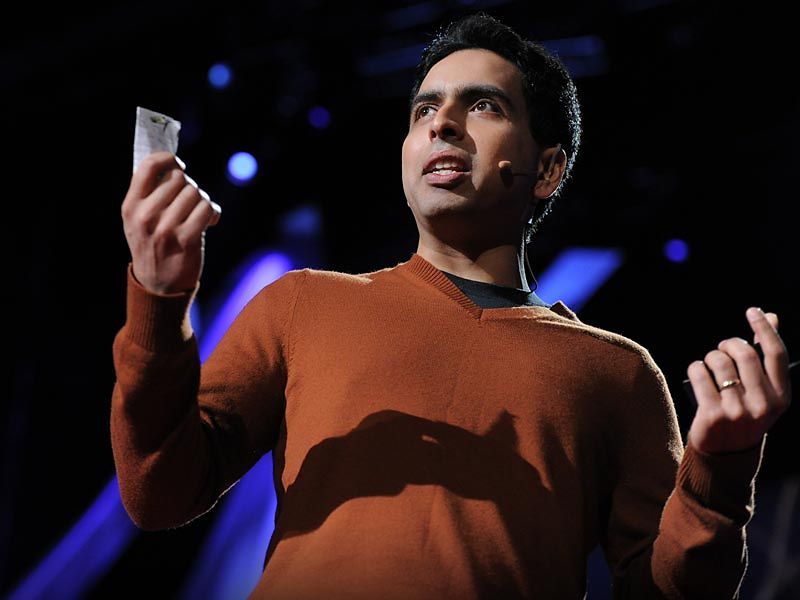
Salman Khan talks about how and why he created the remarkable Khan Academy, a carefully structured series of educational videos offering complete curricula in math and, now, other subjects. He shows the power of interactive exercises — and calls for teachers to consider flipping the traditional classroom script — give students video lectures to watch at home, and do you “homework” in the classroom with the teacher available to help. (Recorded at TED2011, March 2011, in Long Beach, California. Duration: 20:27)
Watch Salman Khan’s talk on TED.com where you can download it, rate it, comment on it and find other talks and performances from our archive of 800+ TEDTalks.


Rui Cardoso commented on Apr 1 2011
Uma excelente apresentação de um trabalho inovador para a educação.
Pingback: another look at an alternative way to teach children. the Khan Academy : La Mesa Grande
Jean-Michel Mermet commented on Mar 31 2011
Do some of these material will be available in other languages ?
Pingback: Sir Ken Robinson-Multiple Intelligences
Pingback: Khan Academy is an Indictment of Education | Action-Reaction
Pingback: Reinventing education | BenCrowder.net
Pingback: More than Mere Words « A Lighter Shade of Grey
Pingback: Salman Khan Talk at TED 2011 | Joel's Scattered Thoughts
Pingback: Let’s use video to reinvent education | weiterbildungsblog
Pingback: Khan Academy – repensando a educação com aulas em vídeo « Enio de Aragon
commented on Mar 17 2011
Do Khan’s science videos (and science videos in general) promote meaningful learning? Please check out this must-watch video: http://bit.ly/KhanEffectiveness
Pingback: UPS, TED, BPM and The Adjustment Bureau |
Pingback: Technology is Bringing Peace Through Education | u4Ya.ca/blog - Rational Reasons to be Hopeful for the Future
Felipe Cruz commented on Mar 14 2011
This is awesome, I’ll check it out right away!
I think that this system will allow for real learning at academic institutions. It will refocus learning from a “memorize and repeat” to a “question and experience” process. As Khan pointed out, this system will free the teacher and students to focus in the *thinking*, in the creative part, rather than in the process of accumulating facts or correct answers.
This sounds very exciting and best of all, it is made available for free!
Pingback: Gates’ Future of Education Straight Out of ’60s | JetLib News
Scott Armstrong commented on Mar 13 2011
Answer: no more formal ‘learning’ institutions. Get qualified on the job as you learn the practical skills and knowledge required. Part of every job will require a certain amount of research by employees.
Experience trumps academic knowledge any day.
Pingback: Conexão TE » Blog Archive » Khan Academy – repensando a educação com aulas em vídeo
Pingback: We Need More Sal Khans | Hack Education
Pingback: EdReach Show #12: Use “Penguins” as a Default | Ed Reach
Bill Harrison commented on Mar 9 2011
Elephants in the room: Will people be able to obtain advanced degrees for free if they can prove mastery of higher level technical courses online? What if there was an equivalent course/testing system for high school…could students conceivably skip high school if they demonstrate mastery of what they need to know? What does this mean for education and academia in general?
Bill Harrison commented on Mar 9 2011
Or if they just learn the material online and are tested in academia, same question.
Kazi Siddiqui commented on Mar 19 2011
Let me put it this way: I don’t understand why the demonstration of mastery shouldn’t be regarded as more important than traditional academic structures, including classes, degrees, etc etc. Even Derek Muller uses the same yardstick to gauge the effectiveness of teaching methods.
Syed Aliraza commented on Apr 8 2011
Yes Harrison, this could be plan in same way, like if someone have knowledge of anything, he/she can have an open test through any accredited authority. I personally have seen this system in some countries, where usually technical experts who just got hands on trainings without any certifications, come to get certified under any Trade Testing Board sort of authority..
Kazi Siddiqui commented on Mar 19 2011
Excuse me? Education is what is important, not little pieces of paper certifying what a good little boy you have been.
Syed Aliraza commented on Apr 8 2011
You are right Siddiqui, education should be for the sake of knowledge and wisdom. But somehow somewhere these little pieces of paper or in modern days online profiles proving educational achievements also have some worth, we can’t totally deny this. But YES, we can revisit the ways and regulations of obtaining these pieces… like the age limitations etc.
Sarabeth Reingold commented on Mar 25 2011
In many colleges, you can take an aptitude/mastery test to prove that you’re allowed to skip certain pre-req coursework. This could free up time for more advanced courses that develop creativity and advanced analytical thinking, that one can usually only get from collaborative group courses. Khan Academy is incredible as a vocational instrument, but is it teaching independent thought? I’m not sure…
Also, Academia as we know it today is a business. If someone could walk in and test out of a major, then the school would lose 4 years of tuition, plus its prestige as being elite and selective would be jeopardized.
Maxime Bonin-Francoeur commented on Mar 25 2011
Also the purpose of school isn’t necessarily to acquire skills for a job… ;-)
TM Lutas commented on Apr 5 2011
If employers will accept it, then it will work. If employers do not accept it, no amount of jaw jaw will fix it.
There is a testing out for US high schools. It is called the GED test. Generally if you’re breathing and 16 you can test out of HS.
Alisa Touzeau commented on Apr 10 2011
@Bill Harrison,
There’s already at least one way, and probably more. My friend has used the CLEP test for college credit several times.
http://apps.collegeboard.com/cbsearch_clep/searchCLEPTestCenter.jsp