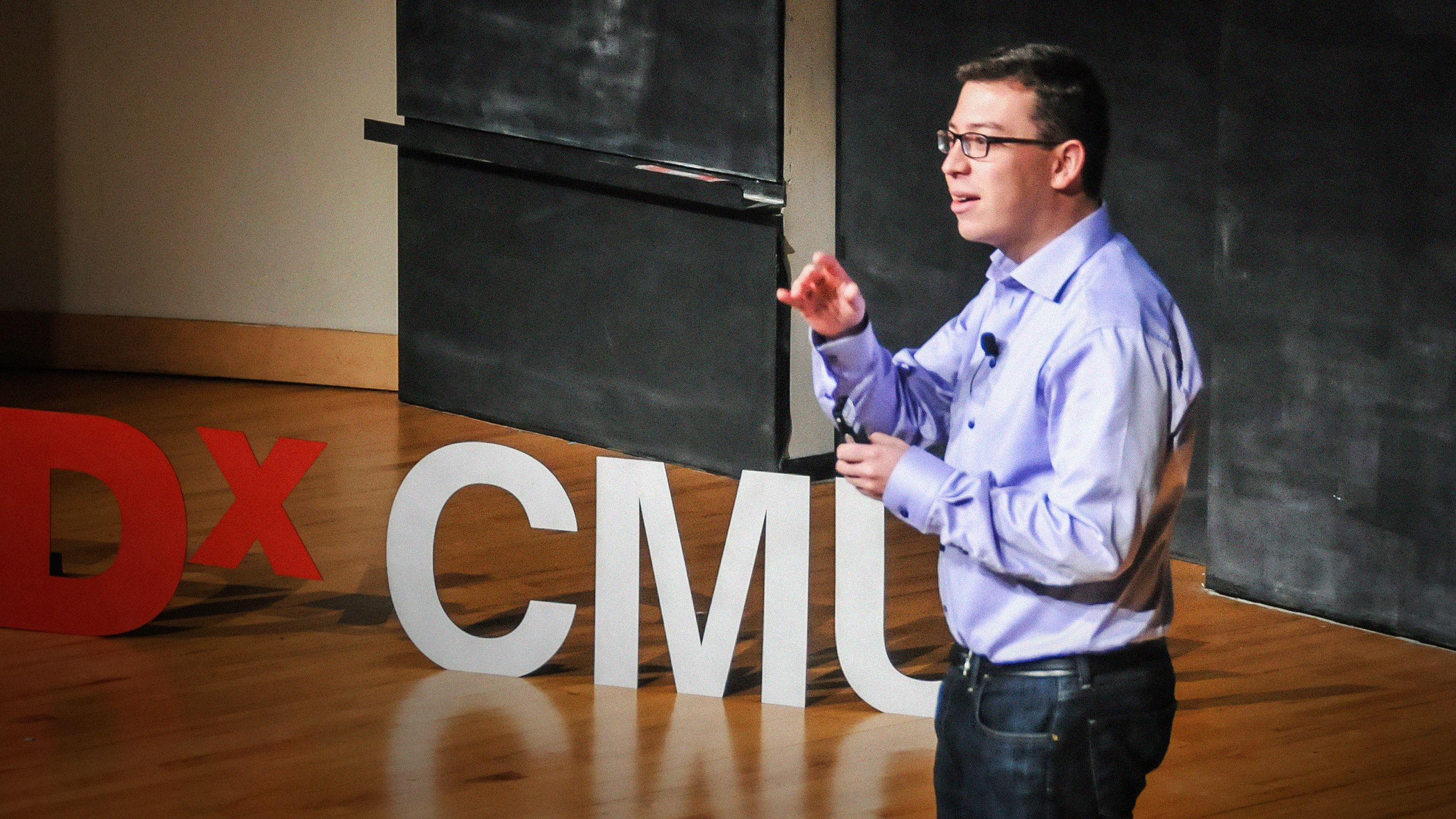
After re-purposing CAPTCHA so each human-typed response helps digitize books, Luis von Ahn wondered how else to use small contributions by many on the Internet for greater good. At TEDxCMU, he shares how his ambitious new project, Duolingo, will help millions learn a new language while translating the Web quickly and accurately — all for free. (Recorded at TEDxCMU, April 2011, in Pittsburgh, PA. Duration: 16:40)
Watch Luis von Ahn’s talk on TED.com, where you can download it, rate it, comment on it and find other talks and performances from our archive of 1,000+ TEDTalks.


Pingback: Duolingo | Linguistics 212
Pingback: Weekly Wrap « Exploring Apprenticeship
Pingback: Summer Learning, Summer Fun « Mr. Honea's Math Page
Pingback: Have you met TED?
Pingback: CAPTCHAs: What are the funniest CAPTCHA combinations? - Quora
Pingback: Security updates - CAPTCHA | Scalr Blog
Pingback: When life gives you lemons, create an engaging web experience. |
Pingback: Duolingo | Psychology and Technology
Pingback: Friday Thoughts - Feb 24 - How to constructively respond to feedback | Friday Thoughts
Ferdinand Roseboom commented on Feb 15 2012
For the Nobel Prize he’d just need to get the millions of Farmvillians to plant and tend real crops and FeedEx and others to ship them for free. It would be the end of world hunger.
Pingback: Translation Guy » Learn a Language, Work for Free: Part 1
Pingback: Prevesti Internet na sve jezike? Digitalizovati sve knjige? Što da ne i to odmah « Pozitivna praksa
Nakul Khanna commented on Jan 4 2012
This talk is simply brilliant and the ability to build a business model out of CAPTCHA even more so
Pingback: Re: captcha | Net Cleaner
Pingback: 2 in 1: Learn a Language and Help Translate the Web! | AGGREGATE
Penelope Vos commented on Dec 25 2011
Hi Luis, this is truly awesome, in the traditional sense.
I think it deserves a Nobel Prize for the concept alone, even before it fulfills its potential to change the world.
If you never include Esperanto, Duolingo will give even poor people a chance to learn a economically powerful language (providing that they have hundreds of hours to study and the same amount of internet connection time), and will show the economically powerful that non-English-speakers exist and think and create.
If you do include Esperanto, which is designed to take a fraction of the time to learn- no more than one sixth compared to another European language, then you will both include more poor people in your gift and include more of the wealthy but distracted, who are unsure of whether they can learn another language, or whether the effort is justified.
Esperanto is a linguistic middle-ground which provides the opportunity for all global citizens to communicate on a equal basis.
Besides that, there is also good evidence that learning Esperanto first facilitates and motivates the learning of subsequent languages.
I hope that you will give this serious consideration and would be happy to coordinate collaboration to include Esperanto in your list.
Thanks again for your gifts to the world to date, and for the inspiration they provide by showing what can be done with better thinking.
Pingback: Massive-scale online collaboration: Luis von Ahn on TED.com « Hieu 4.0
Pingback: Weekly Speaking Latino Links: 9 Dec 2011 | Speaking Latino