[ted id=1546]
The open-source programming world has a lot to teach democracy, says Clay Shirky.
In this fascinating talk from TEDGlobal 2012, Shirky harkens back to the early days of the printing press. At the time, a group of “natural philosophers” (who would later adopt the term “scientists”) called the Invisible College realized that the press could offer a new way to share and debate their work. However, because printing books would be far too slow for this purpose, they came up with a new invention — the scientific journal.
So what does this mean for us today?
Shirky explains, “If I had to pick a group that I think is our Invisible College — our generation’s collection of people trying to take new tools and press them into the service of, not more arguments, but better arguments — I’d pick the open-source programmers.”
Shirky explains a fact that any programmer knows well — that it is very hard to write instructions computers know how to execute. It’s a problem that’s complicated when more than one programmer is on the case, as it’s easy for them to have different ideas on what will work and to create incompatible instructions.
“The problem of managing a large software project is the problem of keeping this social chaos at bay,” says Shirky.
Software engineer Linus Torvalds saw a solution to this problem—“git,” a system that allows for collaborative development. Building on that, Tom Preston-Warner, Chris Wanstrath and PJ Hyett created GitHub.com, a hosting site that allows multiple programmers to work on the same source code at the same time, with changes getting unique signatures. [edit: thanks to commenters for the clarification]
“A programmer in Edinburgh and a programmer in Entebbe can each get a copy of the same piece of software. They both can make changes, and they can merge them after the fact, even if they don’t know of each other’s existence,” says Shirky. “This is cooperation without coordination. This is the big change.”
Shirky believes that this same idea management system could easily be used in democratic governments. In fact, he says, there’s just one big reason this isn’t happening yet — that legal experts rarely know about open-source computer programming.
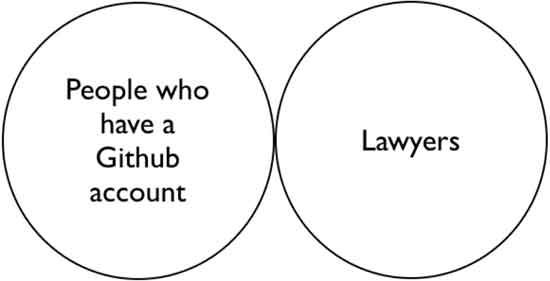
“The law is another place where there are many opinions in circulation and they need to be resolved into one canonical copy,” says Shirky. “There’s the very interesting possibility that this could be used to further the development of legislation.”
To hear more about how this could work, watch Shirky’s laugh-out-loud talk. Below, Shirky gives more resources for anyone looking to learn more about how GitHub could be used in government.
Shirky writes to the TED Blog:
What’s so interesting to me about GitHub isn’t just that it provides new ways to collaborate — though it does that, beautifully — but that it also helps create new social norms. Because the core operation in GitHub is ‘diff’ — what are the differences between two pieces of text — it elevates “Show me” as a social norm. Expressing, clearly and comparably, where you think a particular piece of text could or should be changed for the better becomes a core operation, and, as I said in the talk, the possibility of those social norms being transplanted into democratic politics would be a remarkable change.
So, for people interested in transplanting what programmers have learned about arguing and collaborating into the political realm, here are some good places to start:
Seminal writings
- Abe Voelker: GitLaw: GitHub for Laws and Legal Documents — a Tourniquet for American Liberty
. - Hacker News Commentary on the Voelker essay
. - Quora conversation: What are the nontechnical barriers to adopting a version control system for use in writing bills / new laws? (This is the source of Ari Hershowitz’s wonderful “People with GitHub accounts”/”Lawyers” Venn diagram above and in the talk.)
Political Uses
- Wired article on Stefan Wehrmeyer’s post-TED move to put the German government’s legal documents on GitHub
. - Wehrmeyer’s GitHub repository
. - The Pirate Party’s Liquid Democracy tool
. - A speech from Silja Ómarsdóttir, a participant in the design of Iceland’s crowdsourced Constitution.
. - An essay by Thorvaldur Gylfason, another participant in the Icelandic effort, on the terms of the citizen-designed Constitution.
. - Ireland’s upcoming attempt at a similar model, presaging a transition from what Jürg Steiner calls ‘election-centered democracy’ (citizens elect representatives and then withdraw) to ‘talk-centered democracy’ (citizens stay engaged throughout the political process).
Related Attempts
- Docracy, a tool for sharing legal documents, mostly for contractual language
. - Techcrunch article about Docracy
. - Everyme, a private social network, puts its privacy policy on GitHub
Interview
- Andrian Kreye of Süddeutsche Zeitung interviewed me at TED about the talk. It’s in German, but the title is translated: Politicians will never be obsolete.
Comments (23)
Pingback: GitHub and Developers: The perils of licensing after code release. « Mirsky & Company, PLLC
Pingback: TED News in Brief: The (real) secret to a great infographic, Ai Weiwei at Alcatraz, and more
Pingback: TED News in Brief: The (real) secret to a great infographic, Ai Weiwei at Alcatraz, and more | BizBox B2B Social Site
Pingback: TED News in Brief: The (real) secret to a great infographic, Ai Weiwei at Alcatraz, and more | Best Science News
Pingback: New York Based Web Design | SEO | Social Media Marketing | Email Marketing | Lead Generation | NY | TED News in Brief: The (real) secret to a great infographic, Ai Weiwei at Alcatraz, and more
Pingback: J DuClos » GitHub for Lawyers
Pingback: The GitHub Democracy | Disruptive Ideas from leaders on the edge
Pingback: Existence, uplift, and science news |Trax Asia™
Pingback: Existence, Uplift, and Science News | CONTRARY BRIN
Pingback: He really does look like Tom Hanks | Paul Miller